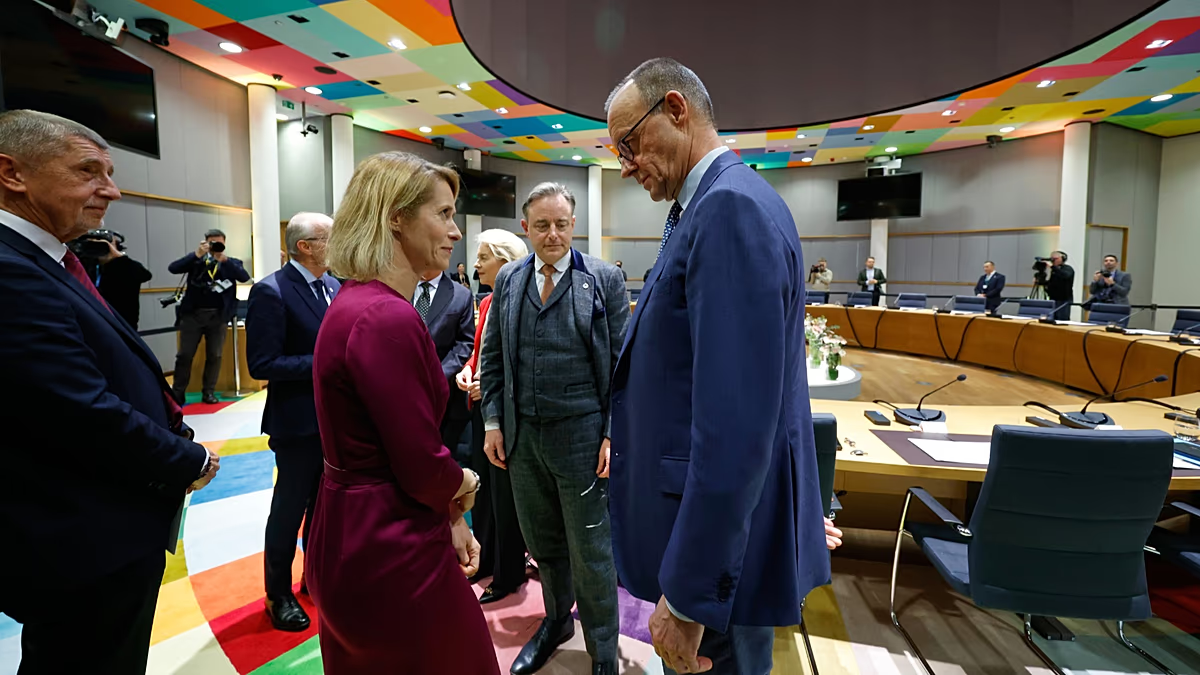
EU leaders gathered in Brussels to discuss relations with the US after a diplomatic roller-coaster of a week that saw Donald Trump threaten, then withdraw, plans to impose additional tariffs on European nations to force the sale of Greenland.
The European Union will defend its interests, citizens and businesses « against any form of coercion » and will use the tool at its disposal « if and when necessary », the European Council President said following a meeting of EU leaders on Thursday.
The summit in Brussels, largely devoted to transatlantic relations, capped off a week of intense diplomatic back-and-forth between the EU and US after Donald Trump threatened to impose tariffs in a forceful attempt to seize Greenland.
Trump’s decision to renege on his threat is « positive », Antonio Costa said, and the EU will continue to « engage constructively » with the US on areas of shared interests, but it will « stand up » for itself if necessary.
Leaders also discussed Trump’s Gaza Board of Peace and emitted doubts over its compatibility with the UN Charter and elements related to its scope and governance, according to the president of the European Council.
France, Italy and Sweden, who have been invited by Trump to join the Board, have indicated they will not participate due to legal and political concerns.
Relive the day as it happened, from Davos to Brussels, with our blog below.


${title}
Live ended
That’s it from us!
Eighteen hours after we started this live blog, it is finally time to bid you good night.
Thanks for coming along on the ride!
EU leaders demand respect from Donald Trump
The leaders of the European Union have demanded respect from Donald Trump after the United States president brought the transatlantic alliance to the precipice of collapse with his threat to seize Greenland through the use of punitive tariffs.
Trump suddenly backtracked on Wednesday, opting instead for a long-term deal on Arctic security brokered by NATO Secretary General Mark Rutte.
« We believe that relationships between partners and allies should be managed in a cordial and respectful way, » António Costa, the president of the European Council, said on Thursday evening at the end of an extraordinary summit in Brussels.
Read the full story by Jorge Liboreiro:

EU leaders demand respect from Trump after Greenland crisis
The battered state of EU-US relations took centre stage at an extraordinary summit of leaders in Brussels, who demanded respect from Donald Trump. #EuropeNews
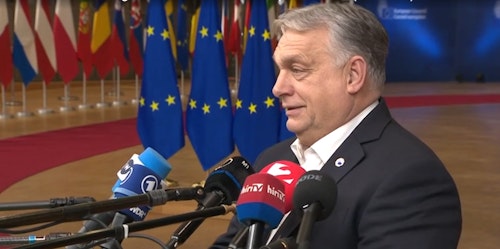
US threats on Greenland ‘not a European issue, it is a NATO issue’ – Orban
Hungarian Prime Minister Viktor Orban stopped on the red carpet to talk to journalist before leaving the European Council.
When asked about Greenland and the US, he said the issue shouldn’t be dealt with at the EU level.
« We have always thought that this was not a European issue – it is a NATO issue, » Orban said, adding: « So when two countries are members of the same organisation, which focuses on security, NATO is the right place to discuss and channel different opinions. »
He praised the work of NATO Secretary General Mark Rutte who negotiated a framework deal on the future of Greenland with Donald Trump who then dropped his threat to impose an additional 10% tariff on the European countries that had sent troops to Greenland last week.
« He has done a good job in helping to consolidate the situation. Now it is easier for you (Danish) than it was two days ago, » Orban said.
Von der Leyen keeps markets guessing on Mercosur deal’s provisional launch
European Commission President Ursula von der Leyen said on Thursday that her institution has yet to decide whether to provisionally apply the contentious Mercosur trade agreement, following talks with the bloc’s 27 leaders.
The deal was signed last weekend in Latin America after EU countries backed it in a crucial qualified majority vote. Its ratification, however, remains uncertain after MEPs voted this week to challenge the agreement before the European Court of Justice, effectively suspending the process and handing a win to opponents who argue it would create unfair competition for EU farmers. The Commission – a strong supporter of the deal – still retains the option of launching provisional application.
“The provisional application was raised by several leaders tonight, there is a clear interest that we ensure that the benefits of this important agreement apply as soon as possible,” von der Leyen told reporters after the EU summit, adding: “We have not yet taken a decision.”
The Mercosur agreement would create a free-trade area of 700 million people between the EU and Argentina, Brazil, Paraguay and Uruguay.
Supporters of the deal, including Germany and Spain, are pushing for provisional application, arguing that shifting geo-economic realities make it essential to secure access to new markets and forge new alliances. Opponents, led by France, lost a key vote at the EU Council on 9 January that paved the way for the signing of the deal, but have kept up the fight in the European Parliament, which must still give its consent for ratification.
Tensions remain high after MEPs voted this week – by a narrow margin of 10 votes – to back a legal referral.
“This is not serious, we are in a situation of geopolitical tensions and 10 votes send the deal to the court of justice,” a diplomat from a country supporting the agreement said, adding: “There is a lot of anger.”
On Thursday night, von der Leyen noted that procedurally the Commission can move ahead with provisional application as soon as one or more Mercosur countries complete their own ratification processes. “We will be ready when they are ready,” she said.
EU and US ‘close’ to agreeing to a unified Ukraine Prosperity Framework – Von der Leyen
The EU is « close » to an agreement with the US for a single unified prosperity framework for Ukraine that could be rolled out when a peace deal with Russia is agreed, Ursula von der Leyen said during the end-of-summit presser.
As we reported earlier, von der Leyen presented the Ukraine Prosperity Framework to EU leaders tonight, which aims to develop and rebuild Ukraine through 2040.
The document, von der Leyen said, represents « the collective vision of the Ukrainians, the Americans and Europe for Ukraine’s post-war future » and would be built around five pillars:
- increasing Ukraine’s productivity through business-friendly reforms and greater market competition;
- accelerating Ukraine’s integration into the EU single market through reforms in key economic sectors;
- significantly scaling up investment, using instruments that already exist and have proven their worth including the Ukraine Investment Framework, which is part of the €50 billion Ukraine facility;
- improving donor coordination, especially among G7 countries and other partners, and with the private sector;
- strengthening fundamental reforms to reinforce the rule of law, anti-corruption efforts and to modernise public administration – all necessary to build trust with investors.
« This agreement on the prosperity framework is a very important milestone, » von der Leyen said. « We are almost done. We are now actively preparing Ukraine’s future as a modern, sovereign, and free country. »
The total cost of reconstruction and recovery in Ukraine is estimated €506 billion over the next decade, according to a study released in February 2025 commissioned by the Ukrainian Government, the World Bank Group, the European Commission and the UN.
The estimate only covers damage incurred between 24 February 2022 and 31 December 2024.
‘Serious doubts’ on the compatibility of the charter of the Board of Peace with the UN Charter
That is what European Council President António Costa told journalists during the concluding press conference.
He said that the Council also had doubts about the elements of the Board of Peace related to its scope and its governance.
He said the EU remains willing « to work together with the US on the implementation of the comprehensive Peace Plan for Gaza, with a Board of Peace carrying out its mission as a transitional administration », in accordance with UN Security Council Resolution 2803 of October 2025 which endorsed the US-backed ‘Comprehensive Plan to End the Gaza Conflict’.

EU welcomes Israel-Hamas deal and reiterates call for two-state path
The EU has been lambasted as “irrelevant” by Israeli Prime Minister Benjamin Netanyahu in a recent interview for L’Observatoire de l’Europe. #EuropeNews
Spain will not join Trump’s Board of Peace, Sánchez says
Spanish Prime Minister Pedro Sánchez rejected Donald Trump’s invitation to join the Board of Peace for Gaza, which was inaugurated on Thursday in Davos.
« It is clear that this board is out of the UN framework and has not included the Palestinian Authority. Palestine’s future should be decided by Palestinian people (…) in a process implementing the two-state solution and guaranteeing peace, » Sánchez told journalists after the end of the extraordinary summit in Brussels.
« When we speak about the future of the Palestinians, we do so in coherence and consistency with our commitment to the multilateral order, to the United Nations system, and to international law, » Sánchez said.
The Spanish prime minister also considers that « the United States is not respecting international law and has introduced tensions in the relations with the European Union ».
He told journalists he is not aware of the details of the so-called Greenland framework deal, agreed between the US and Denmark, but he assured that the EU is ready to deploy the tools at its disposal « to respond in a proportional way » to any possible threats by the US.
« Today’s first message is the unity, solidarity, and support to Denmark and to the people of Greenland, » Sánchez said.
Spain in favour of EU-Mercosur deal’s provisional application
Spanish Minister Pedro Sánchez said that his government would support the provisional application of the EU-Mercosur trade deal, which has just been referred to the Court of Justice by the European Parliament.
The application could be decided by the European Commission, but it is controversial, as several members of the Parliament would consider it as disrespectful to their prerogatives.
« We agree that (the deal) is applied. As it has happened with other trade agreements, the Court has to clarify the legality of certain aspects of the deal, but its application has been approved by the Council, » Sánchez said.
Our goal is ‘effective stabilisation’ of EU-US trade relations – Costa
European Council President Antonio Costa said the decision by the US to drop its tariff threat « is positive » as it would have been « incompatible » with the trade deal the two sides struck last year.
« Our focus must now be on moving forward in the implementation of that deal, » he said. » The goal remains the effective stabilisation of the trade relations between the EU and the US ».
The EU, he went on, « will continue to defend itself » against « any form of coercion ». The bloc has the tools to do so and « we will do so if and when necessary ».
Merz, Macron, Meloni among leaders skipping end of summit statements
Most leaders have already left deciding against talking to the press. These include German Chancellor German Merz, Italian Prime Minister Giorgia Meloni and French President Emmanuel Macron.
We will bring you live coverage from the press conference with European Commission chief Ursula von der Leyen and European Council President Antonio Costa.
The summit has ended
The extraordinary EU summit has come to an end.
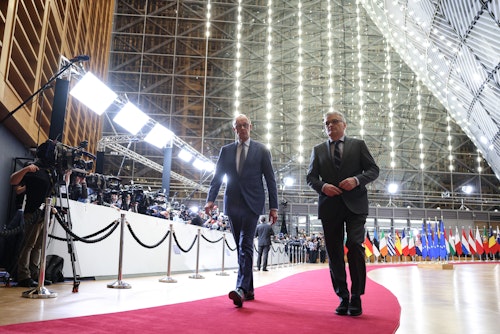
Deal on Greenland includes sovereign bases for US army – New York Times
A lot of obscurity remains over the deal that made Donald Trump abandon his tariff threats to seize Greenland. In a new report, the New York Times offers more details of what could be on the table.
There are four main elements:
- A new NATO mission in the Arctic.
- An update to the 1951 agreement between Denmark and the US to give the US wider access to Greenland.
- The construction of sovereign military bases in parts of Greenland to allow the US to develop its Golden Missile defence system.
- Restrictions to prevent Russia and China from extracting rare earths below Greenland’s ice sheet.
The New York Times notes that these elements have been discussed within NATO for over a year, but that nothing is yet final. A senior Danish official cited in the story said: “There have been no direct discussions between Denmark and the US about the possibility of granting the US sovereign parcels of land.”
Ukraine secures new air defence package
Volodymyr Zelenskyy, who was in Davos earlier today where he delivered a speech in which he castigated Europe for not learning from its mistakes fast enough, said he is returning home « with agreements on a new package of critically needed air defence ».
Zelenskyy also said in his speech that he had had a very good meeting with US President Donald Trump and that a first trilateral meeting involving US, Ukrainian and Russian negotiators would meet in the UAE on Friday and Saturday.
Davos. Support for Ukraine. Air defense for Ukraine. Meetings for Ukraine.
We are returning home with agreements on a new package of critically needed air defense for the protection of our people. pic.twitter.com/o0PezBKvXJ
— Volodymyr Zelenskyy / Володимир Зеленський (@ZelenskyyUa) January 22, 2026
EU-Mercosur deal expected to be raised during today’s extraordinary summit
The EU-Mercosur free trade deal, which was recently concluded at political level, is expected to be raised during today’s extraordinary summit.
The reason is due to the decision by the European Parliament to refer the deal, which is hotly contested by farmers, to the Court of Justice in Luxembourg, a move that could derail its implementation by two years or more. The vote in Parliament was approved with just 10 votes in favour.
« This is not serious. We are in a situation of geopolitical tensions, » said a diplomat from a country in favour of the deal. « There’s a lot of anger. »
However, the European Commission, which has exclusive competence on trade policy, could decide to apply the deal provisionally after the first Mercosur country ratifies it. For the Commission to take such a step, it would need strong political backing to weather the all-but-guaranteed backlash from MEPs and farmers.
Leaders are having dinner without phones
The 27 leaders are having dinner and examining the state of EU-US relations without their phones in the room, a traditional practice for highly strategic discussions.
Trump says the Greenland deal is being ‘worked on’
Donald Trump has shared a new message on his Truth Social platform about Greenland, the very issue that triggered today’s extraordinary summit.
In his new message, he seems pleased with the agreement that he reached on Wednesday with NATO Secretary General Mark Rutte, which convinced him to abandon his 10% tariff threat.
« Heading back to D.C. It was an incredible time in Davos, » Trump wrote. « The Greenland structure is being worked on, and will be amazing for the U.S.A., and the Board of Peace is something that the World has never seen before — Very special. So many good things happening! »
Slovakia’s Robert Fico blasts EU summit as ‘super expensive dinner in Brussels’
Slovakia’s Prime Minister Robert Fico has shared a video of himself on his way to the EU summit. In the video, he describes today’s meeting, convened over the weekend in reaction to Donald Trump’s tariff threats, as a « simply super expensive dinner in Brussels, considering the costs of a government aircraft and an unprepared summit. »
« In general, it’s true that we should not ignore Brussels. But neither should we become victims of the incompetence of EU leadership, » he adds. He then calls for the resignation of High Representative Kaja Kallas and decries « excessive » climate legislation.
THE SAME RULE APPLIES TO THE EU AS TO A MASSAGE PARLOR: IF IT DOESN’T WORK, IT’S NOT ENOUGH TO CHANGE THE BEDS — YOU HAVE TO CHANGE THE STAFF. pic.twitter.com/0injG6Dfcr
— Robert Fico 🇸🇰 (@RobertFicoSVK) January 22, 2026
Watch: EU leaders hold minute of silence for victims of Spain train crash
Spanish Prime Minister Pedro Sánchez has shared a video of the moment EU leaders stood in silence in memory of the 45 victims killed in a train collision in Adamuz, southern Spain, on Sunday.
« Together, in silence, Spain receives today the embrace of all Europe. Thank you, » Sánchez posted.
Juntos, en silencio, España recibe hoy el abrazo de toda Europa.
Gracias. pic.twitter.com/4beQ1vDVQP
— Pedro Sánchez (@sanchezcastejon) January 22, 2026
Danish PM stopped by the UK before heading to Brussels
Mette Frederiksen visited Keir Starmer, her British counterpart, earlier this afternoon before heading to Brussels.
« They agreed that security in the Arctic was a matter for the entire NATO alliance, and Europe and NATO would continue to drive forward progress. The leaders also discussed how the UK and Denmark could deepen broader security cooperation, both bilaterally and across Europe, including through increasing interoperability between militaries, » Downing Street said in a readout.
They also discussed Ukraine and the next steps for the Coalition of the Willing, as well as the situation in the Middle East.
Prime Minister @Keir_Starmer 🇬🇧 welcomed @Statsmin Mette Frederiksen 🇩🇰 to Chequers today
They agreed that security in the #Arctic was a matter for the entire #NATO alliance, and Europe and NATO would continue to drive forward progress pic.twitter.com/DPqEPCXhQz
— UK Joint Delegation to NATO (@UKNATO) January 22, 2026
Analysis: After Trump tariff shock, Europeans hold tight to the alliance
A common message has emerged from all the arrivals of EU leaders: the transatlantic alliance is too big to fail.
« You don’t just give up on this transatlantic alliance. We’ve built it up over 75 years. It is the most successful political alliance that there has ever been between Europe and America, » said German Chancellor Friedrich Merz.
Still, the magnitude of Donald Trump’s ultimatum cannot be understated. Let’s remember that, for a total of five days, the US president threatened to impose extra tariffs on eight European countries to force the sale of Greenland, the mineral-rich island that belongs to the Kingdom of Denmark. It was an attempted assault on the sovereignty and territorial integrity of an EU and NATO member state. For most capitals, it was blatant blackmail.
This is why messages from EU leaders on Thursday were a calculated mix of hope and dismay, relief and caution, reflecting the volatility of transatlantic relations in the second Trump era, where nothing can be taken for granted.
« The transatlantic relations have definitely taken a big blow in the last week. But I think in this one year, we have learned that these relations were not the same as they were. On the European side, we’re not willing to junk 80 years of good relations, and we’re ready to work for this, » said High Representative Kaja Kallas.
« Trust has always been the most important foundation for our relationship with the United States, » said Polish Prime Minister Donald Tusk. « What we need today in our politics is trust and respect among all partners here, not domination and not coercion. It doesn’t work in our world. »
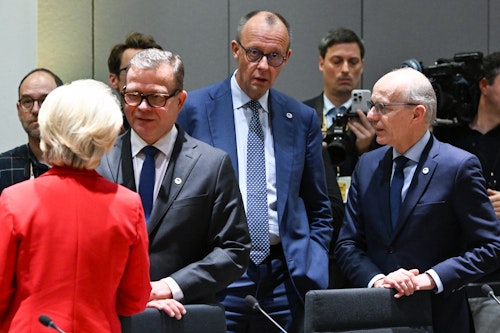
VDL to unveil Ukraine’s Prosperity Roadmap proposal to leaders tonight
Commission President Ursula von der Leyen will tonight present before EU27 leaders the Ukraine Prosperity Roadmap, aimed at developing and rebuilding Ukraine through 2040, two EU sources told L’Observatoire de l’Europe.
This is the first time the Commission will discuss the content before the 27 leaders. The document was presented to ambassadors at COREPER this morning.
No Metsola press conference
We have just been informed that European Parliament President Roberta Metsola will not hold a press conference after she is done addressing leaders. She holds press conferences during formal summits, but not informal gatherings, as this one is.
Leaders are set to discuss the Board of Peace. Why do they have reservations?
Only two EU countries, Hungary and Bulgaria, have so far signed up to the White House’s controversial Board of Peace for Gaza, first pitched in the 20-point peace plan agreed between Israel and Hamas last year. Concerns voiced about the board so far include:
- The board’s charter, which makes no mention of Gaza, over-reaches its original mandate and risks supplanting the United Nations.
- The board also grants sweeping powers to Trump, with fears he could retain the role after his presidency.
- Russian President Vladimir Putin has been granted a seat on the board along with his Belarusian ally President Alexander Lukashenko, making it politically untenable for most European governments to join.
- No Palestinian names have been included on the two senior boards that have been appointed to steer the board.
- The board’s charter makes no reference to the two-state solution that the EU sees as the only viable path to long-term peace for the region.
Here’s a few shot of leaders before they got down to business
EU summit begins with a minute of silence for train crash victims in Spain
The extraordinary summit of EU leaders has officially begun.
Before the debate on EU-US relations began, António Costa, the president of the European Council, shared a message of condolences on behalf of all leaders to Spanish Prime Minister Pedro Sánchez for the victims of the recent tragic train accidents in Spain. The leaders then observed a minute of silence in respect for the victims, an EU official said.
Merz and Meloni have their own bilateral
Italian Prime Minister Giorgia Meloni held a bilateral meeting with German Chancellor Friedrich Merz, perhaps explaining why she skipped the doorstep area and speaking to journalists.
Slovenia’s PM says Trump’s Board of Peace does not promote a two-state solution
Slovenia’s Prime Minister Robert Golob has been speaking about why his government declined the US’s invitation to join the Board of Peace.
« At the moment, we declined it. Why? Not because we don’t want to see Gaza prosper in peace, absolutely we would like to see that, but there are too many questions regarding the scope of the Board of Peace, » he said. « We don’t want the Board of Peace to supplant the UN. »
Golob added that it’s « only the UN » which can « bring a long-term and lasting solution for Gaza, which is the two-state-solution. »
« And we don’t see that in the charter of the Board of Peace, unfortunately, » he concluded. « But if that changes, we would be glad and willing to get on board. »
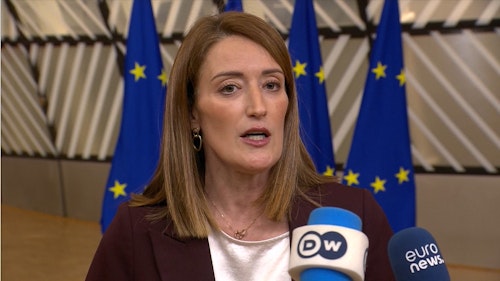
Metsola: European Parliament ready to ‘continue our internal discussions on the EU–US trade deal’
European Parliament President Roberta Metsola expressed her readiness to move forward on the EU-US trade deal that was frozen this week by MEPs following Donald Trump’s tariff threats.
« I will be taking this forward together with my colleagues at the Parliament in order to make progress, » she said.
She also indicated that she was working with members of the US House of Congress. « We can work together, have a dialogue, find solutions, and build bridges. On trade, you see a lot of alignment.We need a fair partnership with the US, which is in the interest of all. »
« As we have seen after the high tensions this week, it looks like, for now, cool heads have prevailed, » she said. « We have learned that we need to be strong, but at the same time we need stability. »
EU lawmakers freeze EU-US trade deal after Trump tariff threat
The move will intensify tensions between Brussels and Washington ahead of a summit where EU leaders are set to weigh their response to Trump’s escalating threa…
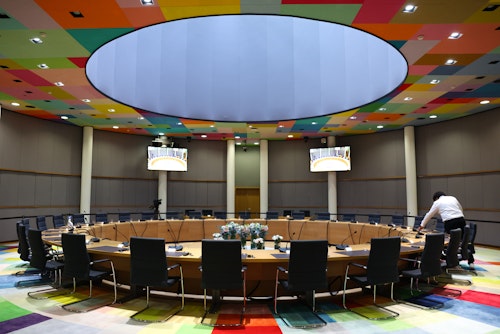
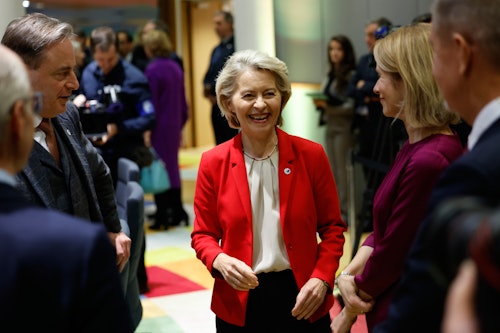
EU leaders are gathering in the room
EU leaders are gradually gathering in the room ahead of their dinner devoted to the turbulent state of transatlantic relations. The mood appears relaxed following yesterday’s reversal by US President Donald Trump, who said he would no longer impose tariffs on European countries nor seek to acquire Greenland.
Credit: Associated Press.
Italian PM Giorgia Meloni arrived at the informal EU Summit
Italian Prime Minister Giorgia Meloni has arrived at the European Council to attend the informal summit.
She did not, however, take questions from journalists.
‘We are here to de-escalate, not escalate’ – Cyprus President
Nikos Christodoulides, whose country Cyprus now holds the presidency of the Council of the EU, said Thursday that EU leaders would seek ways to ease tensions with the US rather than inflame them.
“We are here to de-escalate and not escalate the situation,” Christodoulides told reporters, adding: “We are here in order to find a positive way forward without, of course, any compromise on territorial sovereignty and integrity of any member states.”
The Europeans have spent recent weeks pushing back against repeated US demands to acquire Greenland, Denmark’s semi-autonomous territory. Tensions escalated further after US President Donald Trump threatened tariffs on EU countries that did not agree to the purchase of the Arctic island.
As president of the European Council for six months, Cyprus faces the delicate task of uniting EU member states around a common response to Washington.
Last Sunday, a group of countries including France, Germany, and Spain signalled their willingness to adopt a tougher stance, raising the prospect of using the EU’s Anti-Coercion Instrument – a powerful trade defence tool that some countries feared could further escalate tensions with the US.
On Thursday night, EU leaders are expected to draw lessons from the week’s crisis and outline the future of transatlantic relations, one year after Trump’s return to power, which has deeply destabilised the world order.
Macron brings his new look to the EU summit
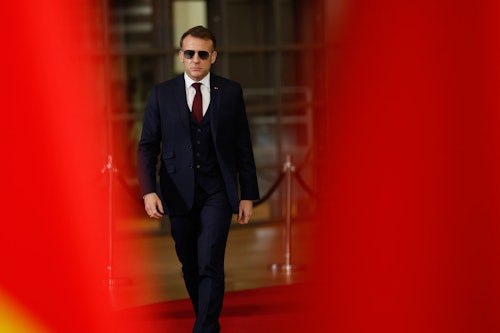
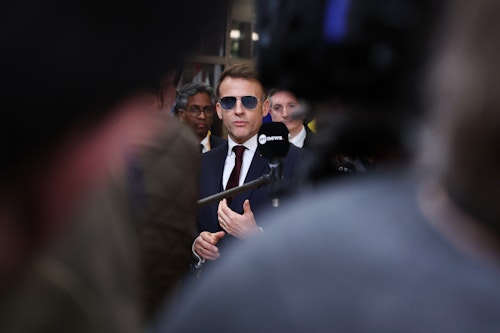
Credit: Associated Press.
Macron now meeting Frederiksen
Following on from his bilateral meeting with the German leader, Emmanuel Macron is now meeting with Mette Frederiksen, the Danish prime minister, the Elysée just said.
EU can ‘work with’ the Board of Peace if it is ‘narrowed down to Gaza’, Kallas says
The EU’s foreign policy chief Kaja Kallas has weighed in on the controversy around US President Donald Trump’s Board of Peace, calling for a return to its original mandate of overseeing Gaza’s post-war transition.
The Board has been criticised for its sweeping mandate and for a glaring lack of focus on the Palestinian territory. Several EU countries, including France, Belgium, Germany, Italy and Sweden, have indicated they cannot sign up to the board in its current form, with some voicing concerns it could undermine the mandate of the UN.
« In the United Nations Security Council resolution, the Board of Peace was foreseen, but it was for a limited time until 2027 and also with a clear path for how Palestinians would take over,” Kallas said.
“We want this Board of Peace to be limited to this UNSC resolution as it was foreseen. So if it is narrowed down to Gaza, we can work with it.”
Some leaders are cautious not to reject their invitations outright. Italian Prime Minister Giorgia Meloni said last night that it wouldn’t be a « smart choice for Italy and Europe to exclude themselves » from the body completely.
But Putin’s membership on the board also makes the EU’s membership politically untenable while the war in Ukraine still rages. The Russian President has said he is willing to pay the $1 billion contribution that Trump has demanded for permanent membership on the board.
Transatlantic relations have taken a ‘big blow’ this week, says Kaja Kallas
High Representative Kaja Kallas has arrived at the EU summit.
« The transatlantic relations have definitely taken a big blow in the last week. But I think in this one year, we have learned that these relations were not the same as they were. On the European side, we’re not willing to junk 80 years of good relations, and we’re ready to work for this, » she told reporters in Brussels.
« Our strength comes from unity. When we’re ready to act to defend our values, to defend our interests, this is the signal we need to send. Both to our adversaries and (to) our allies. »
Kallas insisted the EU and the US were still « allies » despite the unprecedented crisis created by Donald Trump’s tariff threat, which put the entire alliance on the verge of collapsing.
« Although I think everybody is relieved with the recent announcements, we have also seen that in this one-year period, we are ready for a lot of unpredictability. So we still need to discuss our plans for different scenarios. Because one day, one way, the other day again, everything could change, » Kallas said.
« The word for this year has been unpredictability, and this is what we’re living through. »
Kallas also urged both the EU and the US to focus their energy on ending Russia’s war on Ukraine, lamenting « we haven’t seen any concessions from the Russian side », and warned that any impression of fracture in the alliance would benefit « our adversaries ».
« So hopefully we are investing in our transatlantic relationship so it would be stronger to stand up for threats that are actually there, » she said.
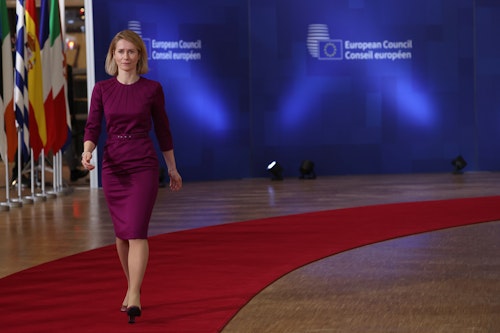
Credit: Associated Press.
EU-US relationship ‘intense’ and active’ – Latvian PM
Latvia’s Prime Minister described the transatlantic relationship as « intense » and « active » and better than not having a relationship at all
Asked if the US can still be trusted, Evika Silina said that it’s not for her « to evaluate do we trust or do we not. We need to work with what we have », and Trump, she said, is the elected leader of the US.
« Politics and diplomatics (sic) always are complicated, » she added, saying that it’s « important » for EU leaders to gather and discuss this.
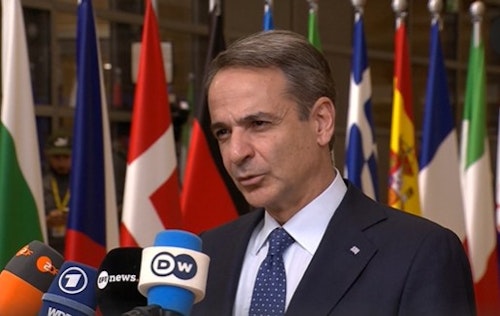
Mitsotákis: ‘There is room to explore a reasonable compromise’
Greek Prime Minister Kyriákos Mitsotákis told journalists that he’s welcomed the statements made by President Trump yesterday in Davos.
« There is room to explore a reasonable compromise that would respect the sovereignty of Denmark and Greenland, » he said. « I recognise the challenges, but I do believe that if we remain united, firm yet constructive, a solution can be found. »
Lithuania’s President: Anti-coercion tool against the US is ‘not the way’
Lithuania’s Prime Minister Gitanas Nausėda told reporters ahead of an informal council meeting that Europe should prioritize “cooperation” over “confrontation” with the US, saying “we can solve all the issues if we propose a positive agenda to our colleagues in the US.”
Nausėda insisted that threatening the US with anti-coercion tools was “not the way ».
“I still treat the US as our closest friend,” he said.
Macron: ‘We remain extremely vigilant and ready to use our tools if there are further threats »
With his aviator sunglasses perched on his nose, French President Emmanuel Macron spoke to journalists of his relief that the situation has now become « more acceptable » following « a form of escalation, threats of invasion, and tariff threats » earlier in the week.
However, he added that « we remain extremely vigilant and ready to use our tools if there are further threats. »
He said the upheavals for the past week showed that « when Europe acts in a united manner and uses the tools at its disposal, it can command respect, and that is a very good thing ».
« This is the policy Europeans want to pursue: we stand for peace and stability. We are for international order being calm, and when we are threatened, it is normal that there is solidarity. »
He said the objectives of the extraordinary summit are « to show European unity in support of Denmark, its territorial integrity, and to affirm that when Europe is united, strong, and reacts quickly, order and calm are restored. »
But he also said that they will discuss military exercises « NATO will have to organise ». « France is fully available to participate. »
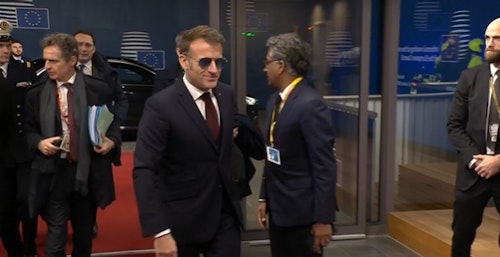
Macron and Merz meeting now
French President Emmanuel Macron and German Chancellor Friedrich Merz are currently holding a pre-summit bilateral, the Elysée has said.
EU-US ties remain ‘very critical,’ Irish PM says
Irish Prime Minister Micheál Martin said on Thursday that the EU-US relationship remains highly sensitive, following days of tension between Washington and the EU over the fate of Greenland.
Speaking on arrival at an EU summit, hours after the US and NATO Secretary General Mark Rutte announced an agreement on the Arctic island, Martin said that “the EU-US relationship is still very critical relationship,” both economically and geopolitically.
“The interdependence economically is so strong and so vast that undermining that would have serious repercussions for Europeans and US citizens,” he said.
Martin also said US companies he met in Davos had expressed anxiety over the situation.
After nearly a week of crisis, during which several EU countries were targeted by US President Donald Trump with tariff threats unless they agreed to his demands over Greenland, the Irish leader said Europe had shown “unity, firmness and principled positions in terms of sovereignty of national and territorial integrity.”
He said both sides now needed to stabilise relations and follow through on commitments already made.
“We have a trade agreement with the US that we should maintain and that both the EU and the US should honour.”
Danish Prime Minister thanks Europeans for their support and unity
Upon arriving at the summit, Danish Prime Minister Mette Frederiksen thanked Europeans for their support during the crisis over Greenland triggered by Donald Trump’s tariff threat.
« I would like to express how grateful we are in the Kingdom of Denmark, including Greenland, for all the support we have received from all over Europe, » she said.
« It has been extremely important in this very difficult situation that we have been placed in. I think when Europe is not divided, when we stand together, and when we are clear and strong, also in our willingness to stand up for ourselves, then the results will show. »
Trump ‘respects’ Europe if ‘we are strong and united,’ Finnish Prime Minister says
“I think that Trump, he respects us if we are strong and united,” Finland’s Prime Minister Petteri Orpo just said to reporters upon his arrival.
Referring to the negotiations over the future of Greenland, he said: “What is important now is to negotiate, but we need to keep all the tools we have as the EU on the table and we need to be ready to use it if needed.”
He also said Europe needs a « clear strategy » on how to strengthen the Arctic, saying Finland is ready to work to bolster the security of the region.
US deal over Greenland cannot violate our sovereignty, says Danish prime minister
Danish Prime Minister Mette Frederiksen has arrived at the EU summit and made it clear that any agreement with the United States to solve the tensions over Greenland cannot and will not infringe upon the sovereignty of the Kingdom of Denmark.
Frederiksen said she has asked NATO to be « more present » in the Arctic region. « We need a permanent presence from NATO in the Arctic region, including around Greenland, » she says. At the same time, her country will discuss bilateral relations with the US in a more « traditional political » manner.
« I think it’s clear to everybody that we are a sovereign state and we cannot negotiate about that. Because it’s a part of the very basic democratic values. But of course, we can discuss with the US how we can strengthen our common cooperation in the Arctic region, » Frederiksen told reporters.
« We have said from the very beginning that a discussion about our status as a sovereign state cannot be discussed; it cannot be changed. We’re willing to work together with the US, as we have always done about security. But our red lines (is that) our democratic rules cannot be discussed. »
Asked if she could still trust the US after Trump’s tariff threats, the Danish leaders said cooperation has to take place « respectfully, without threatening each other. »
« I hope to find a political solution within the framework of democracy and how we cooperate as allies, » she said, noting the 1951 bilateral agreement should be the basis of talks.
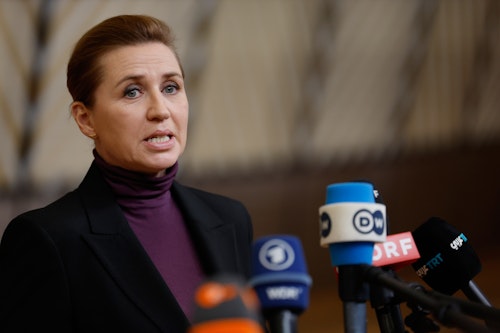
Credit: Associated Press.
‘You don’t just give up on the transatlantic alliance’ – Merz
German Chancellor wouldn’t be drawn to comment on the events of the past week including the threat by US President Donald Trump to impose more tariffs on some European countries to force the sale of Greenland, but he said he attaches « great importance » to the relationship with the US.
« We should try to preserve NATO, » he also said.
« You don’t just give up on this transatlantic alliance. We’ve built it up over 75 years. It is the most successful political alliance that there has ever been between Europe and America, » he said.
Socialist leaders meet ahead of the European Council
Socialist leaders, including Spanish Prime Minister Pedro Sanchez and European Council President António Costa met in Brussels at the Party of European Socialists ahead of the Council to coordinate their positions ahead of the summit at 27.
Reminder: Leaders will focus on relations with the US following the threats, now withdrawn, from Washington to slap an addtitional 10% tariff on six member states over Greenland.
Spanish Prime Minister @sanchezcastejon arrives at the #PESleaders #EUCO preparation meeting on EU-US relations. pic.twitter.com/fQCQjIUbTc
— PES 🌹🇪🇺 (@PES_PSE) January 22, 2026
Polish PM: ‘The US is absolutely the main partner when it comes to security’
Entering the European Council, Polish Prime Minister Donald Tusk talked of his attachment to the transatlantic relation despite having « an obvious crisis with the United States. »
« Because of my personal experience, geography, and history, I am absolutely sure we need to protect our relationship against all odds and problems, » he said before adding that the United States is absolutely the « main partner when it comes to security. »
« We accept the leadership of the United States; it is something absolutely natural, he said, adding however that « it is important to distinguish between domination and leadership ».
« Trust has always been the most important foundation for our relationship with the United States, » he said. « What we need today in our politics is trust and respect among all partners here, not domination and not coercion. It doesn’t work in our world. »
France seizes ‘shadow fleet’ vessel, Macron announces ahead of EU summit
France has seized a Russian oil tanker belonging to the « shadow fleet, » French President Emmanuel Macron announced just hours before the EU summit in Brussels. The vessel, Macron said, was under international sanctions and suspected of carrying a false flag, a practice that Moscow often employs to bypass Western oversight. A judicial probe has been launched, he added.
« We will not tolerate any violation, » Macron said on a social media post. « We are determined to uphold international law and to ensure the effective enforcement of sanctions. The activities of the ‘shadow fleet’ contribute to financing the war of aggression against Ukraine. »
Macron’s announcement comes as Ukrainian President Volodymyr Zelenskyy, speaking in Davos, castigated European countries for not doing enough to crack down on the « shadow fleet », which provides a fundamental source of revenue to finance the invasion of Ukraine.
« Thank you, France! » Zelenskyy said in his reaction to Macron’s announcement. « Sanctions against the entire infrastructure of the shadow fleet must be tough. Vessels must be apprehended. And wouldn’t it be fair to confiscate and sell the oil carried by these tankers? »
We will not tolerate any violation.
This morning, the French Navy boarded an oil tanker coming from Russia, subject to international sanctions and suspected of flying a false flag.
The operation was conducted on the high seas in the Mediterranean,… pic.twitter.com/zhXVdzPx1r
— Emmanuel Macron (@EmmanuelMacron) January 22, 2026
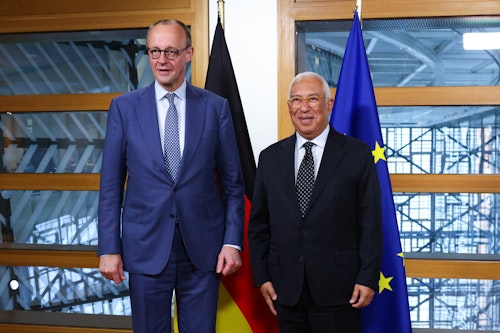
Costa and Merz held bilateral before EU summit
Before the emergency summit on Thursday evening, António Costa, the president of the European Council, held a bilateral meeting with Friedrich Merz, the federal chancellor of Germany.
« As European NATO allies, we must do more to secure the High North. This is a common transatlantic interest. Germany is doing this in the framework of NATO. Denmark and the people of Greenland can count on our solidarity, » Merz said earlier today, referring to Donald Trump’s U-turn on tariffs.
There was ‘no negotiation with NATO about our sovereignty’ – Denmark’s Frederiksen
In an interview in Copenhagen Thursday, Danish Prime Minister Mette Frederiksen Frederiksen said « there has been no negotiation with NATO yesterday about our sovereignty ».
Frederiksen’s interview came after Trump on Wednesday abruptly scrapped the tariffs he had threatened to impose on eight European nations to press for US control over Greenland, a semiautonomous territory of NATO ally Denmark. It was a dramatic reversal hours after he insisted he wanted to get the island “including right, title and ownership” — though he also said he would not use force.
Frederiksen said said Denmark is « ready to do more » but that it is better for the US, Denmark and other NATO members « that we work together as allies, that we look after our common security interests together ».
« There is no doubt that we in NATO need to rearm. We are in the process of doing this nationally, and we are doing it on the eastern flank, and we must also do it on the northern flank, but it has to be within the rules of democracy, » she added.
She also said that Denmark will continue « to engage in dialogue » with the US, adding: « We also have a common interest in ensuring that there is no Chinese or Russian investment. Neither in my eyes in the United States nor in Europe. »
Watch: European leaders ‘are not sure what to do’ about Greenland, says Zelenskyy
Speaking in Davos, Volodymyr Zelenskyy said Europe lacks a clear response to global crises, pointing to uncertainty over Greenland and the failure to support protests in Iran.
He warned that inaction signals to authoritarian leaders that violence can secure power. pic.twitter.com/g0XLTfzsrs
— L’Observatoire de l’Europe (@L’Observatoire de l’Europe) January 22, 2026
What to expect from today’s EU summit?
The 27 leaders of the European Union are expected in Brussels for an extraordinary meeting later today. Initially convened to coordinate the response to Donald Trump’s threats, the summit will now focus on a broader discussion about the state of EU-US relations following his sudden U-turn on Greenland.
The relation « remains sometimes volatile in some areas, and it is important for the leaders to come together and discuss how they understand this new reality, this is a new normal in this structural relation between Europe and the United States, » said a senior EU official.
« We have a strong and certainly more complex relation with the United States, where there are questions where we disagree, » the official added. « But it’s important that we keep and develop that cooperation. It’s complex, but we have to live with that complexity. »
Leaders will debate Greenland, Arctic security, trade, defence and the need to reinforce the EU’s strategic autonomy. Another issue that will be discussed is the invitation to join Trump’s Board of Peace, which most member states have received. There are « strong doubts » about the project due to its expansive mandate and possible incompatibility with the United Nations, the official noted. However, no « coordinated approach » is expected to emerge after today’s summit because Europeans are still engaging with their American partners to address the concerns and clarify the wording of the board’s founding charter.
There was ‘very strong support’ to trigger ACI if Trump had moved ahead with tariffs– senior diplomat
A senior EU diplomat told journalists today that the EU’s Anti-Coercion Instrument (ACI) would likely have been triggered by member states had Trump made good on his now-withdrawn tariff threats.
« I noticed that in all the discussions we had — already on Sunday evening, and then even more clearly afterwards — there was very strong support if the tariff were imposed, » he said, opining that governments had toned down their willingness to use it in their public statements.
« Some member states and the Commission believe it is better not to say » that they want to deploy the ACI, the diplomat said. « It is a tactical consideration. »
Activating the ACI would require the backing of at least 55% of member states representing at least 65% of the EU population.
The diplomat also pushed back against the nicknaming of the ACI as the bloc’s « trade bazooka ».
« It is the opposite of a nuclear attack or a bazooka, » he said. « Those are things that are used only once, as a last resort, and are not meant to be used at all — and if they are, there is no going back. »
« The anti-coercion instrument is exactly the opposite. It can be used in an agile, reversible way, proportionately or not. »

EU holds back trade ‘bazooka’ to defuse Greenland tensions with US
European Union countries will not yet deploy the anti-coercion instrument (ACI) in response to Trump’s Greenland tariff threats, people familiar with the matte…
Today’s dialogue with US was not simple but positive, Zelenskyy said following Trump meeting
Ukrainian President Volodymyr Zelenskyy said that his meeting with Donald Trump « went well » while speaking on stage in Davos.
« The meeting is very important. We need, in our boat, this ship to peace, the United States, » he said.
He also praised his team, saying: « Our team worked well. This last mile has been very difficult. Today’s dialogue was not simple, but it was positive. »
Zelenskyy confirmed that the “first trilateral meeting” between Ukraine, Russia, and the United States will take place tomorrow in the United Arab Emirates.
« Ukraine is negotiating with full honesty, and that brings results. Russia must also be ready to finish this war, to stop this aggression, » he said.
Reflecting on previous discussions with the US, he said: « Our previous meeting with the President of the United States brought us air defense missiles. I hope America will continue to stand with us. »
Zelenskyy suggests Russian pressure blocked EU decision on reparations loan
During his speech in Davos, Zelenskyy referred to the reparations loan, the European Union’s proposal to turn the immobilised assets of the Russian Central Bank into a zero-interest line of credit to support Kyiv’s financial and military needs for 2026 and 2027. The plan had no precedent in modern history and raised multiple legal, technical and financial concerns. Belgium, which holds the bulk of the Russian assets, demanded airtight guarantees to endorse the proposal.
In the end, EU leaders agreed to raise €90 billion in joint debt to back Ukraine’s fight, without touching the Russian assets.
On Thursday, Zelenskyy said that Vladimir Putin was still trying to access the immobilised funds and « he’s having some success » at it.
« When the time came to use those assets to defend against Russian aggression, the decision was blocked, » Zelenskyy said. « Putin managed to stop Europe, unfortunately. »
Zelenskyy, however, expressed gratefulness for the EU’s decision to indefinitely immobilise the assets, taken in December last year, to ensure the money does not end up in Moscow’s pocket.
Zelenskyy: Europe is missing in action
The Ukrainian president has taken an unusually critical tone toward Europe today, arguing that the continent is hesitant, divided and focused on other things besides pushing for a ceasefire in Ukraine.
“Europe loves to discuss the future but avoids taking action today,” Zelenskyy told an audience in Davos. “Why can President Trump stop tankers from the shadow fleet and seize oil but Europe doesn’t?”
In another passage, he blamed Europe for turning its attention on Greenland, blocking the use of assets to defend Ukraine against Russian aggression and making little progress on building a Special Tribunal for the Crime of Aggression Against Ukraine.
“What’s missing: time or political will? Too often in Europe, something else is always more urgent than justice,” Zelenskyy said.
He also lashed out against Europe’s focus on security guarantees for post-war Ukraine, and complained that Europeans are constantly divided.
« Too often, the tone is against each other – leaders, parties, movements, and communities – rather than standing together to stop Russia, which brings the same destruction to everyone, » Zelenskyy said. « One of the biggest problems today, though it is not often discussed, is that some European leaders are from Europe, but not always for Europe. »
Zelenskyy warns Europe is still too weak: ‘Nothing has changed’
The Ukrainian president has been blunt in his assessment of Europe’s security weakness, pointing to the Greenland crisis as evidence that it is not ready to defend itself.
« Everyone turned their attention to Greenland, and it is clear most leaders are not sure what to do about it, » Zelenskyy said. « It seems like everyone is just waiting for America to cool down on this topic, hoping it will pass away. But what if it will not – what then? »
« Last year, here in Davos, I ended my speech with the words, ‘Europe needs to know how to defend itself’. A year has passed, and nothing has changed. »
Zelenskyy on blackouts: ‘This is the face of Russia’
One key topic of Volodymyr Zelenskyy’s speech is the plight that Ukrainians are suffering under Russia’s constant bombardment, which has drastically reduced the availability of electricity and forced millions to endure sub-zero temperatures without heating.
« This is the face of Russia, this is the face of this war, » Zelenskyy said during the Q&A session. « We have defensive systems, we are really creative, but it’s not enough, it’s still not enough. »
He then appealed to the US and Europe to step up their provision of air defence systems, which are critical for Kyiv to intercept daily barrages of Russian drones.
« Don’t forget about air defence, don’t forget about Patriots, » Zelenskyy said, referencing his meeting with Donald Trump earlier today. « So this is very important for us during this winter. »
Read more about the situation on the ground.

‘We need help,’ Ukraine energy provider CEO says during Kyiv blackout
Russia has repeatedly hit Ukrainian energy infrastructure throughout the nearly four-year war, but Kyiv says this winter has been the toughest yet.
Zelenskyy on Iran
Volodymyr Zelenskyy is hammering home the main theme of his speech: that European allies are not taking the lead in global security, and are instead leaving the initiative up to Washington.
Citing the example of the recent protests in Iran, he said: « Everyone is waiting to see what the United States will do, while the rest of the world offers nothing. Europe offers nothing and chooses not to engage. »
EU should press ahead with EU-US trade deal, senior official says
An EU senior official said on Thursday that the bloc should move forward with enforcing the EU-US trade deal agreed last summer, after the US withdrew its tariff threats linked to Greenland.
“There is an agreement that should be abided by. We must move forward,” the official said, adding: “The EU respects its agreements.”
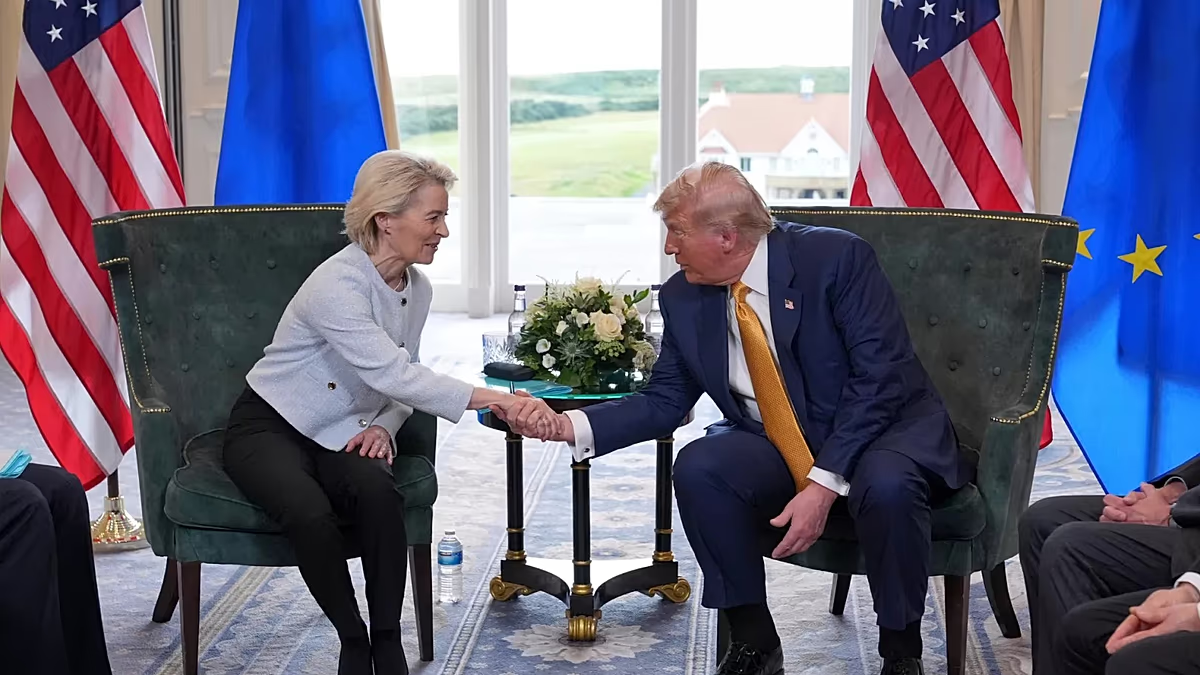
The deal was clinched last summer by European Commission President Ursula von der Leyen and US President Donald Trump after weeks of trade tensions. Under the agreement, EU exports to the US would face 15% tariffs, while the bloc would cut its own tariffs on US industrial goods to 0%.
The agreement, however, still required approval by the European Parliament and was suspended indefinitely on Wednesday after lawmakers viewed Trump’s tariff threats over Greenland as a breach of the deal.
With a potential resolution now emerging on Greenland and Trump saying he would not impose the previously announced 10% tariffs on eight European countries, the senior official said it would be “expectable” for MEPs to relaunch the procedure to implement the deal.
But that outcome is not certain.
German MEP Bernd Lange (S&D), who chairs the Parliament’s trade committee, said on X on Thursday: “Hardly any details are known yet about the proposed Greenland deal. But we need them in order to decide how to proceed with the implementation of the EU-US trade deal.”
Lange added that lawmakers would discuss the issue next Monday and assess “the way forward”.
Zelenskyy: « Europe needs to know how to defend itself »
Volodymyr Zelenskyy is using his speech to the WEF to warn that Europe is not taking self-defence against Russia seriously, and that the events of recent days show that the backstop of US protection cannot be taken for granted. Here’s an excerpt from his remarks:
« Europe relies only on the belief that if danger comes, NATO will act, but no-one has really seen the alliance in action. »
« If Putin decides to take Lithuania or strike Poland, who will respond? Right now, NATO exists thanks to the belief that the United States will act, that it will not stand aside and will help. But what if it doesn’t? »
« This question is everywhere, in the minds of every European leader. Some are trying to get closer to President Trump; some are hoping the problem will disappear. »
« Europe needs to know how to defend itself. And if you send 30 or 40 soldiers to Greenland, what is that for? What message does it send? What’s the message to Putin, to China? And even more importantly, what message does it send to Denmark, your close ally? »
« You either declare that European bases will protect the region from Russia and China and establish those bases, or you risk not being taken seriously, because 30 or 40 soldiers will not protect anything. »
Lutnick: US ‘remains committed’ to EU-US trade deal
US Commerce Secretary Howard Lutnick appears to be trying to repair his image among European leaders after sparking strong backlash with his remarks at the World Economic Forum this week.
Posting a photo of himself smiling in a traditional Swiss restaurant alongside EU Trade Commissioner Maroš Šefčovič, Lutnick wrote on X that “despite the noise and headlines” the US “remains committed to implementing the US–EU trade agreement” and “will always value our deep ties with our friends in Europe”.
Lutnick’s negative comments about Europe earlier in the week angered several Davos attendees. The Financial Times reported that ECB President Christine Lagarde walked out of a dinner while he was delivering a critical speech.
‘No one should doubt our readiness’ in the Arctic – NATO Commander
NATO’s readiness in the High North is in good shape thanks to the « tremendous capabilities » of northern allies, the Supreme Allied Commander Europe said on Thursday.
« No one should doubt our readiness » in the Arctic, General Alexus G. Grynkewich told reporters during a press conference.
« The Swedes, the Finns, all the northern countries, Norway, Denmark, have tremendous capabilities that they bring to bear every single day up there, » he added, noting that the militaries of the alliance’s two newest allies, Finland and Sweden, are « uniquely positioned to strengthen NATO’s northern flank and Arctic security ».
In terms of capabilities needed to secure the region further, he said that the Alliance needs to be more forward-looking.
« Some of the things that we need to do in the Arctic to enhance our security are long lead items, including, you know, installation of new sensors and detection capabilities, » Grynkewich said.
‘No planning yet’ for a NATO Arctic mission
NATO’S Supreme Allied Commander, SACEUR, told the same press conference that the alliance has « done no planning yet » on a potential Arctic mission.
Talks of a possible mission first started after Donald Trump ramped up his expansionist rhetoric over Greenland, the notion being that he might be appeased with a demonstration that the alliance takes the security of the High North and Arctic seriously.
« We’ve never received political guidance to move out. We’re aware of discussions about this, of course, and therefore we’re doing some thinking about how we would organise for it, » General Alexus G. Grynkewich told reporters. « But no, no planning has started yet, » he said.
He did flag that several NATO exercises are planned in the coming months in the Arctic, although none in Greenland specifically.
France requested on Wednesday that NATO look into a joint exercises on the sprawling island, adding that it would be ready to contribute.
European Parliament condemns US visa ban on former Commissioner Breton
The leaders of the European Parliament’s political groups have adopted a joint statement condemning the US’s imposition of a visa ban on former EU Commissioner Thierry Breton and four other European citizens.
The US State Department imposed the ban last December, accusing the targets of forcing American social media platforms to censor users and their viewpoints.
“The European Parliament firmly rejects the visa ban imposed by the US authorities on former Commissioner (Thierry) Breton, which is solely motivated due to his role in the development and implementation of the Digital Services Act, a law proposed by the European Commission and adopted by the co-legislators to protect users online », the statement adopted today reads.
According to the Parliament, this measure is « an unacceptable personalisation of EU policy, a dangerous precedent for the independence of the European Institutions and an attack on the EU’s regulatory sovereignty. »
NATO planners ‘waiting for direction’ on US-Denmark Greenland framework
NATO’s Military Committee is « still waiting for direction » regarding a framework that was agreed on Wednesday between the US and Denmark for Greenland, the chair of the committee told journalists just now.
« We’re still at the very early stage, » Admiral Guiseppe Cavo Dragone told reporters after a Military Committee in Chiefs of Defence Session at NATO headquarters in Brussels.
Once they receive guidance, he added, « we will start doing our business, which is military planning ».
Belgium’s foreign affairs minister: We have « NOT » joined Trump’s Board of Peace
Belgium’s foreign affairs minister Maxime Prévot took to X to deny an earlier announcement that Belgium might join Donald Trump’s « Board of Peace » plan, which aims at solving global conflicts.
Belgium « has NOT » signed the charter, Prévot wrote.
« We wish for a common and coordinated European response. As many European countries, we have reservations to the proposal. »
Most other European countries, including France, the UK, Italy and Norway, have not signed up to the board.
Zelenskyy-Trump meeting has started
L’Observatoire de l’Europe correspondent Sasha Vakulina reports from Davos that the Ukrainian delegation led by President Volodymyr Zelenskyy has arrived to start a bilateral meeting with US President Donald Trump.
Zelenskyy travelled to the World Economic Forum at short notice to meet Trump for further talks on ending the war. Earlier today, Trump said a settlement in Ukraine is coming « soon ».
Zelenskyy is expected to make a speech and also participate in a panel discussion about Ukraine’s post-war recovery. He will also meet energy company representatives.
Rutte: US ownership of Greenland didn’t come up in talks with Trump
NATO Secretary General Mark Rutte has provided more details about the negotiations that led to the « framework » deal over Greenland that convinced Donald Trump to withdraw his controversial tariff threat against eight European countries.
« I don’t think there’s a U-turn, » Rutte told Sky News in an interview, defending Trump’s focus on the Arctic region. « Over the years, he and I had discussions on this. And yesterday, we discussed how we can now tackle this once and for all, making sure the Russians and the Chinese (don’t) gain access to the Arctic region – Greenland, but also the wider Arctic, including the US with Alaska. »
Rutte said it was « clear » for both him and Trump that NATO had a role to play and that these discussions should build on the dialogue launched last week by Danish, Greenlandic and American officials.
Asked if Trump’s idea to own Greenland had been taken off the table, Rutte replied: « We didn’t discuss it. It didn’t come up last night. »
Rutte then insisted the matter of US ownership « did not come up anymore » and underlined the common goal of security. « He (Trump) is the leader of the free world, » he said. « If he’s worried about something, we’d better listen because he might’ve found something that is not good, and that is the issue of Russians and Chinese getting more access (in the Arctic) because these sea lanes are opening up. »
Rutte also praised Trump for « reinvigorating » NATO at last year’s summit, when allies agreed to spend 5% of their GDP on defence, and for focusing the alliance on securing the Arctic against Russia and China. « That is what we discussed. How to do that. How to make it practicable, zoning out bits of Greenland, » he said.
Asked about the European backlash triggered by Trump’s tariff threat, Rutte struck a conciliatory tone and urged allies to ramp up their defence spending and help bring Russia’s war on Ukraine to an end.
« Let’s not drop the ball on Ukraine because we’re so busy with other stuff, » Rutte said. « On Ukraine, they need to make sure they have what they need in terms of military support to sustain the fight. »
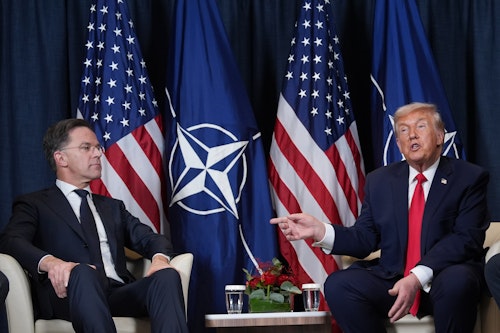
Credit: Associated Press.
Trump: ‘I’m a real estate person at heart, and it’s all about location’
Donald Trump said the Gaza strip is a « great location » and that the Board of Peace will be crucial to change living standards for its people.
« Look at this location on the sea, look at these beautiful pieces of property. What it could be for so many people, it’ll be so great, people that are living so poorly are going to be living so well, » Trump said.
« We put together a team that’s outstanding, a team that’s done it before, a team that I think has done tougher jobs, » Trump said, commenting on the rollout of the Board of Peace.
Trump said that « many others have signed up (to the Board of Peace) » because it « really will be important. This is not going to be a waste of time. We waste so much time on things that never happened. This will happen. And it’s already happening. »
Aleksandar Brezar has more here.

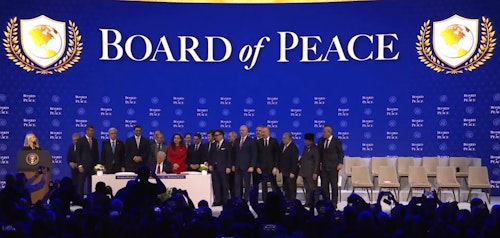
Trump launches ‘Board of Peace’ at Davos signing ceremony
The board originated in the US president’s 20-point Gaza ceasefire plan endorsed by the UN Security Council, but has expanded far beyond its initial mandate.
Marco Rubio says Gaza remains board’s primary focus
US Secretary of state Marco Rubio made clear in Davos that the focus of Trump’s “Board of Peace” initiative would be on Gaza, in an attempt to brush off criticism from many European countries that the board’s stated aims are too broad.
“Now we have this board of Peace whose – I believe – possibilities are endless, obviously with a focus first and foremost on making sure that this peace deal in Gaza becomes enduring,” he said.
Rubio also stated that the initiative reflected “a new era” and should serve as a model to the rest of the world “of what is possible.”
Rubio spoke after Trump during the signing ceremony of the Board of Peace charter. The board’s signatories include the leaders of Azerbaijan, Bulgaria, Kosovo and Hungary, among others.
‘The page is turning,’ says Gaza High Representative for the Board of Peace
Gaza High Representative for the Board of Peace Nickolay Mladenov said the “page is turning” for Gazans, Palestinians and Israelis, and that a “successful turn” will depend on “all of us”.
“Who would have thought two years ago that we would be sitting here with this group of countries with this leadership giving the people of Gaza a new chance?” Mladenov said.
The Bulgarian diplomat also hailed the “great group of countries” joining the board, and said there are « more to come ».
Mladenov urged everyone in the room and watching the Davos meeting remotely to “put their fears and concerns away” and to “stop listening to rumours and gossip”.
Markets bounce back after Greenland tensions defused
Global stock markets rallied on Thursday as US President Donald Trump rolled back tariff threats linked to Greenland.
Trump said he had agreed the “framework of a future deal” on Greenland after meeting with Mark Rutte, NATO’s secretary-general, claiming he would not use military force to seize the island from Denmark, and also dropping plans to impose extra tariffs on several European countries from 1 February.
Details of the future deal are scarce, although investors were visibly cheered by the de-escalation.
Read the full story below.

Markets rally and safe havens fall as Trump touts Greenland deal
Global markets rebounded after the US president shifted his stance on the Arctic island, claiming that a deal is in the works.
Trump: Spain taking a « free ride » in NATO
At the inauguration speech of the Board of Peace, Trump repeated his claim to have ended eight wars in the first year of his second presidency.
« One year ago, the war was on fire; things are calming down, » Trump said.
Talking about NATO, the US President hailed allies who have increased their military spending, but also sent a warning to Spain.
« Spain wants a free ride, I have to talk to them, » Trump said.
In June, Spain asked for an opt-out from NATO’s increased military spending target. In October, Trump said Spain should be expelled from NATO if it did not meet the new spending criteria.
Another EU Country joins the Board of Peace
Bulgaria has become the second country EU country to join the Board of Peace, after Hungary.
Prime Minister Rosen Zhelyazkov, who leads the conservative party GERB, appeared onstage at the signing ceremony alongside Donald Trump and more than 30 representatives of other governments.
Donald Trump begins Board of Peace event
Donald Trump is addressing a ceremony launching the Board of Peace, with around 35 governments already signing up to join – among them Israel, Saudi Arabia, the United Arab Emirates, Bahrain, Jordan, Qatar and Egypt, and NATO members Turkiye and Hungary.
The body is ostensibly meant to resolve international conflicts, with a billion-dollar entry fee for permanent membership.
Hungary the first EU country to join Trump’s Board of Peace
Hungary was the first member state to have accepted former President Trump’s invitation to join his “Board of Peace” initiative, which aims to address global conflicts.
Last Sunday, Hungarian Prime Minister Viktor Orbán, who attended the board’s launch ceremony in Davos today, said that Trump’s invitation signalled that Hungary’s “efforts for peace are being recognised.”
“President Trump has invited us to participate in the work of the Peace Council as founding members. We have, of course, accepted this honourable invitation,” Orbán stated.
The Hungarian government has not yet clarified whether it will pay the $1 billion contribution that guarantees permanent membership. Earlier, the White House noted that countries could pay the $1 billion fee to demonstrate a “deep commitment,” but it was not mandatory.
Besides Hungary, Belarus and Türkiye have joined the board, while France, Sweden, Slovenia, and Norway declined invitations. Germany and the European Union have not committed.
Merz: « Open markets and trade opportunities » are the answer to US « isolationism and protectionism »
In his speech, the German chancellor said the EU’s agenda was clear: “Europe must be the antithesis of state-sponsored unfair trade practices, raw-material protectionism, technology bans and arbitrary tariffs.”
He underlined the progress made by the EU in consolidating trade partnerships, notably with the Mercosur bloc. However, he criticised the European Parliament’s decision to freeze the EU-Mercosur deal by referring it to the EU Court of Justice.
“We will not be stopped,” he added.
Merz also voiced optimism about the EU signing new trade agreements with Mexico and Indonesia, and soon India. European Commission President Ursula von der Leyen is due to travel to New Delhi to sign what she has described as a “historic trade agreement” and “the mother of all deals”.
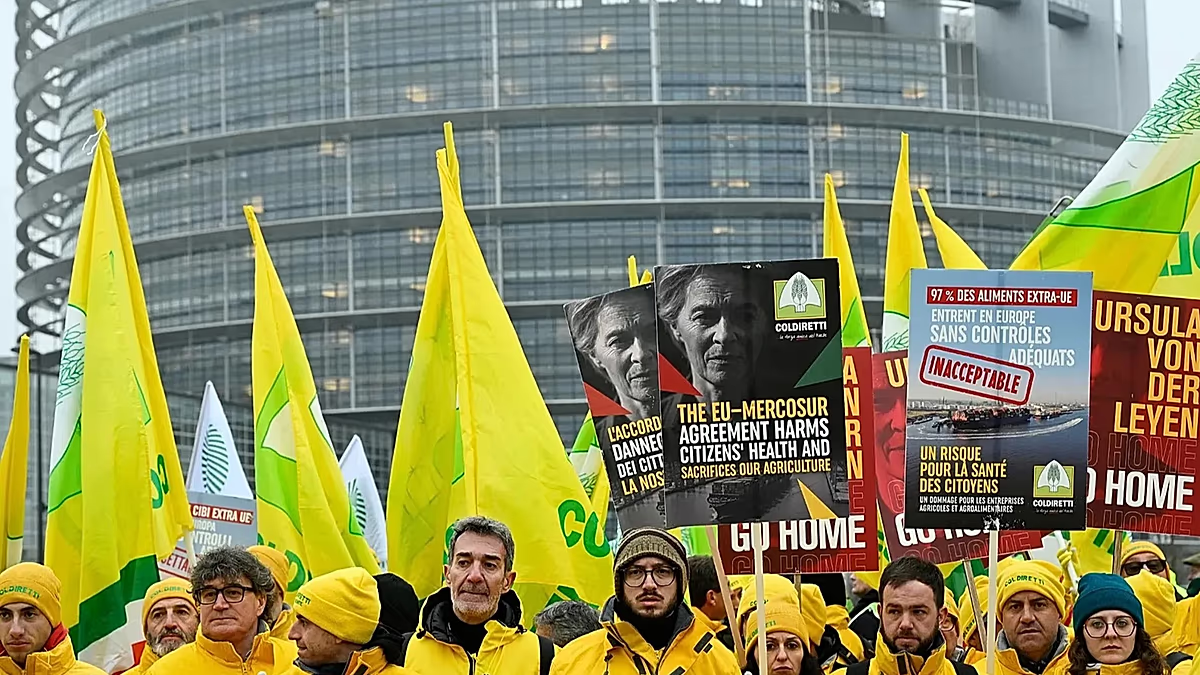
EU-Mercosur trade deal referred to Court of Justice
After clearing major political hurdles after more than two decades, the mammoth trade deal now faces further delay pending a judicial verdict. #EuropeNews
Trump to deliver Board of Peace speech
Our correspondent Sasha Vakulina is in the room where Donald Trump will deliver a speech imminently. He is expected to elaborate on his plan for the so-called Board of Peace, originally meant to manage Gaza’s post-war recovery.
There was no Board of Peace ceremony originally on the WEF agenda, and the event was only announced today at 8:20 CET.
Trump is now repositioning the organisation as a major global alliance, with a $1 billion permanent membership fee. The proposal has rattled Europeans, and only one EU leader says they will be accepting Trump’s invitation to join: Viktor Orbán, reliably the US president’s closest ally in the bloc. However, he has not yet committed to paying the fee.
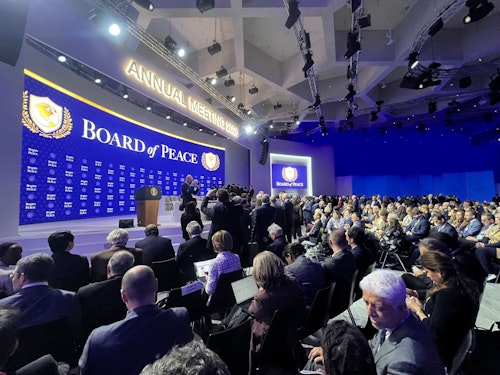
UK becomes latest country to snub Trump’s Board of Peace
Speaking to the BBC from Davos, UK Foreign Secretary Yvette Cooper said her country will not yet be accepting an invitation to join the Trump-led Board of Peace because of concerns about Russian leader Vladimir Putin’s possible participation.
Cooper described the board’s structure as a « legal treaty that raises much broader issues » than the original stated aim of end the Israel-Hamas war in Gaza and managing the devastated enclave’s recovery.
Several other European countries, including France, Italy, Norway and Sweden, have already indicated that they will not sign up to Trump’s plan, at least not yet.
‘Germany needs to regain economic strength to lead the EU’ – Merz
German Chancellor Friedrich Merz said in his speech that Germany has to regain its economic strength for Europe to be a key player in global politics once again.
“Germany can only lead the way in Europe if we are economically strong, » Merz insisted.
Germany’s policies need to be « exceptionally ambitious and courageous, » he said, and progress needs to be made on several fronts – all while maintaining support for Ukraine.
« We want to reduce dependencies that currently make us vulnerable, we want to ensure that our economy can tap into its full potential, » Merz said. « This can only work if we work together as a European Union. »
Belgian king and PM held secret talks with Trump last night
Belgium’s King Philippe and Prime Minister Bart De Wever met with Donald Trump in Davos on Wednesday evening, it has emerged.
US Secretary of State Marco Rubio was also present at the meeting, according to De Wever’s office. Both sides agreed not to disclose any details of the conversation.
« We won’t find out anything about it either. At the request of the United States, that conversation will be kept confidential, » journalist Michaël Van Droogenbroeck told Het Journaal.
‘There is no room for isolationism and protectionism,’ Merz said
Merz told a Davos audience that boosting military capabilities means “to assert our sovereignty” and “strengthen our defence capabilities. »
« There is no room for isolationism and protectionism, » Merz said. « We’re talking about strategically coordinated ties worldwide. »
« We want to be the alliance offering open markets and trade opportunities, and we want to strengthen the rules for fair trade. The anti-thesis for unfair trade, raw material protectionism, and arbitrary tariffs need to be replaced by rules that need to be respected by trading partners, and the EU is making great progress on this,” Merz said, referring to the latest Mercosur trade deal and the upcoming EU-India deal.
Merz calls Europe to act ‘resolutely and sovereignly’ and not give up NATO
German Chancellor Friedrich Merz Merz called on Europe to stand together “resolutely and sovereignly” in this “new age of great powers,” adding that “we should not give up on NATO.”
It is now important, he said, to “repair the trust” on which NATO is built as it is the US “strongest competitive advantage.”
“Democracies do not have subordinates, they have allies and trusted friends,” he added.
Mark Rutte backs Trump on China and Russia in Greenland
At a meeting on the sidelines of the WEF last night, NATO Secretary General Mark Rutte agreed with Donald Trump’s insistence that the Arctic and Greenland “must be defended” from China and Russia.
« Trump is right. We have to do more there. We have to protect the Arctic against Russian and Chinese influence, » said Rutte.
Germany’s Chancellor calls Trump speech in Davos ‘right way to go’
German Chancellor Friedrich Merz said he welcomed Trump’s remarks on Greenland in Davos yesterday, calling them « the right way to go, » because « any threat to acquire European territory would be unacceptable. »
In addition, Trump’s threats on new tariffs would also « undermine the foundations of transatlantic relations, » Merz said.
German Chancellor Friedrich Merz has now taken the stage
Germany was among the countries recently targeted by threats from Donald Trump, who had floated the idea of imposing a 10% tariff after Berlin expressed support for Denmark over Greenland.
Merz is now expected to outline Germany’s position on defence spending and its relationship with the United States and the future of NATO.
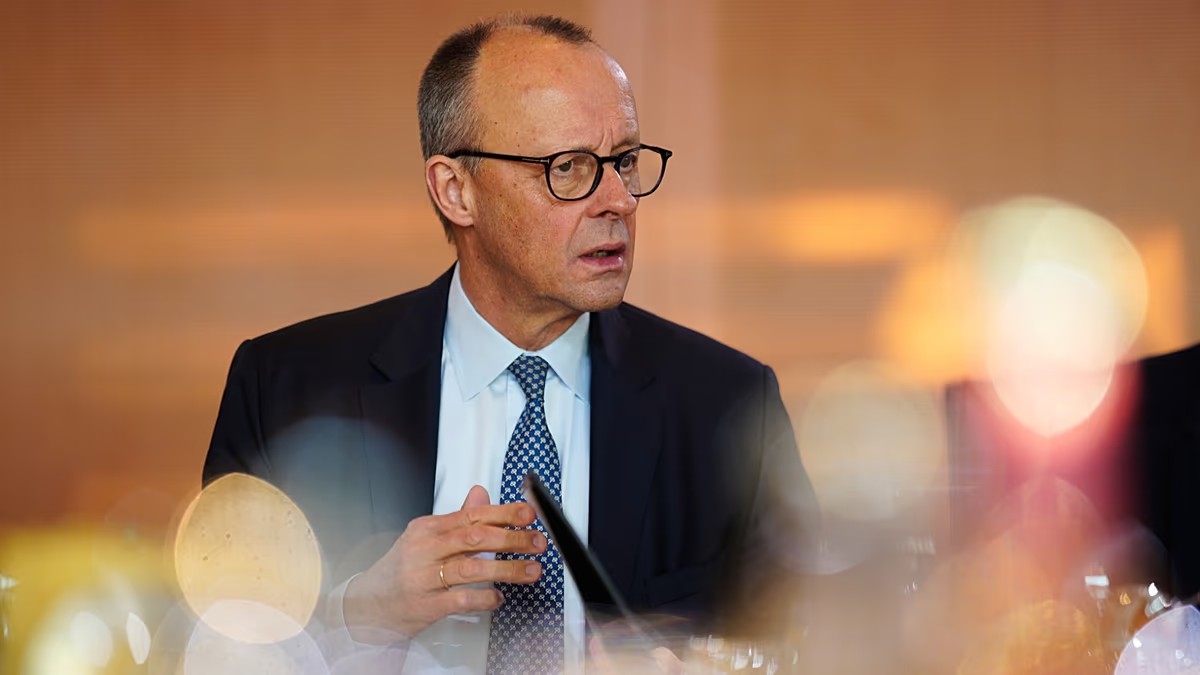
Europe wants to ‘avoid escalation’ with US over Greenland, says Merz
European leaders are closing ranks in response to Donald Trump’s threat of additional tariffs to force the acquisition of Greenland. German Chancellor Friedric…
Italy won’t sign Trump’s “Board of Peace” initiative
Italy will not join Trump’s “Board of Peace” initiative. At least not for now.
The country’s prime minister, Giorgia Meloni, told Italy’s landmark TV show “Porta a Porta” that Italy was “open, willing and interested” in Trump’s proposal, which is aimed at resolving global conflicts.
But there is an issue of “constitutional incompatibility” that “does not allow us to sign immediately.”
“We need more time,” she added.
Putin to pay $1 billion to join ‘Board of Peace’, suggests using frozen assets held in the US
Russian President Vladimir Putin said Moscow is prepared to contribute $1 billion to former U.S. President Donald Trump’s proposed “Board of Peace,” which would make Russia a permanent member.
He added that the funds could come from Russian assets frozen by the United States under the previous administration.
Putin said the remaining frozen assets held in the U.S. could be used to help rebuild areas damaged by fighting following a peace agreement between Russia and Ukraine, noting that discussions on the matter are underway with the U.S. administration.
Italian PM Giorgia Meloni urges allies to ‘dialogue’
Italian Prime Minister Giorgia Meloni welcomed Trump’s announcement of the tariff suspension scheduled for 1 February against Denmark, Finland, France, Germany, the United Kingdom, the Netherlands, Norway, and Sweden.
« As Italy has always maintained, it is essential to continue fostering dialogue between allied nations,” said Meloni.
Accolgo con favore l’annuncio del Presidente Trump di sospendere l’imposizione dei dazi prevista per il 1° febbraio nei confronti di alcuni Stati europei.
Come l’Italia ha sempre sostenuto, è fondamentale continuare a favorire il dialogo tra Nazioni alleate.
— Giorgia Meloni (@GiorgiaMeloni) January 21, 2026
‘We’ve de-escalated, but obviously it’s not over yet,’ says Finnish President
Finnish President Alexander Stubb said on Wednesday evening that an American military seizure or takeover of Greenland is off the table as he laid out the three previously foreseen scenarios — the good, the bad, and the ugly.
« The good would be to find an off-ramp and create a process to improve Arctic security through NATO. The bad one would be to have a tariff war continue, and the ugly one would have been military intervention, » said Stubb.
« We’ve now de-escalated, but obviously it’s not over yet. »
‘The EU cannot be subjected to any kind of neo-colonial behaviour,’ former Commission President said to L’Observatoire de l’Europe
Speaking on L’Observatoire de l’Europe’ flagship programme Europe Today, Jean-Claude Juncker urged the European Union to take a far more assertive stance towards the United States, insisting that Europe must show it is ready to defend its own interests.
Asked what he would do if he were still Commission president, Juncker said he would confront Donald Trump directly to make clear that “the European Union cannot be subjected to any kind of neo-colonial behaviour”.
“The EU is not a slave of the United States of America,” Juncker said, adding that while the US president is aware of this, “he doesn’t take this into account, at least not publicly”.
Commenting on Trump’s more than one-hour speech at the World Economic Forum in Davos, Juncker said it was “less aggressive” than he had expected, but still “not reassuring”. Although the US president ruled out a military attack on Greenland, he reaffirmed his desire to take control of the territory through negotiations, referring to it as a “giant piece of ice”.
Now an adviser to Commission President Ursula von der Leyen, Juncker warned that such threats could have serious consequences for the transatlantic relationship. “If a NATO ally attacks or threatens another NATO ally, this inaugurates a process at the end of which we could witness a breakdown of NATO,” he said.

Juncker: EU should use all available tools to ‘deeply harm US economy’
Jean-Claude Juncker, who led the European Commission during the first Trump administration, told L’Observatoire de l’Europe that the EU “cannot be submitted to the neo-colonial…
Zelensky to join world leaders in Davos
Ukrainian President Volodymyr Zelensky is on his way to Davos to hold talks with President Trump.
The two leaders are set to meet in the Alps on the sidelines of the World Economic Forum (WEF) ahead of planned visits to Moscow by White House envoys Steve Witkoff and Jared Kushner, who are scheduled to meet with Russian President Vladimir Putin.
Both discussions will center on President Trump’s proposed peace plan for Ukraine.
Eyes on Davos and Brussels
Good morning and welcome to L’Observatoire de l’Europe’ live updates from Davos and Brussels on the latest developments in Greenland.
As the sun rises over Davos, Switzerland, L’Observatoire de l’Europe takes a look at what to watch today at the World Economic Forum:
- 09:00 – Conversation with Israeli President Isaac Herzog
- 09:30 – Speech by German Chancellor Friedrich Merz
- 12:30 – Conversation with Finnish President Alexander Stubb
In Brussels, European heads of state and government will gather for a special European Council, where Greenland is expected to be high on the agenda. Leaders will arrive from 17:30, with discussions due to begin at 19:00.
We will keep you updated throughout the day with the latest statements, announcements and reactions from the Davos World Economic Forum and beyond.