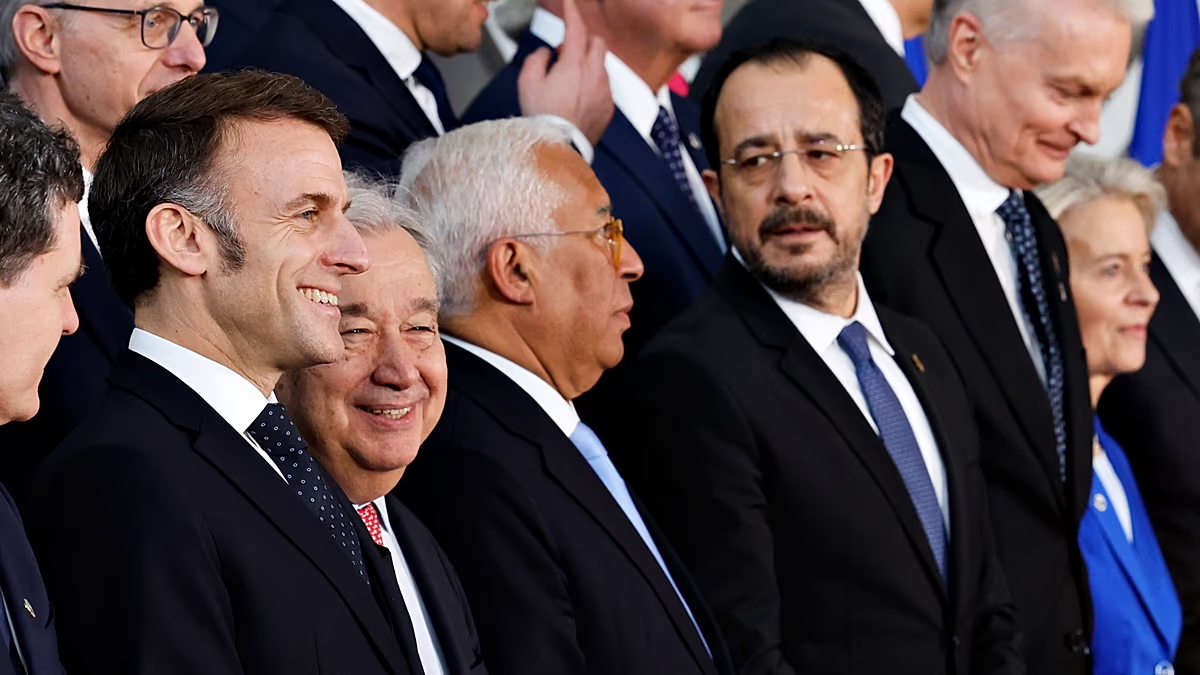
Thursday’s summit of EU leaders was dominated by Hungary’s veto on the €90 billion loan for Ukraine, the spiralling war in the Middle East and the high energy prices that continue to weigh down the economy.
EU leaders concluded on Thursday a summit largely eclipsed by Hungarian Prime Minister Viktor Orbán’s controversial decision to veto the €90 billion loan for Ukraine, which he has linked to the interruptions of the damaged Druzhba oil pipeline.
« We are ready to support Ukraine when we get our oil, which is being blocked by them. Until then, there is no decision that is favourable for Ukraine, » Orbán said on Thursday.
António Costa, the president of the European Council, harshly criticised Orbán’s veto, saying « nobody can blackmail » the institutions and their decision-making.
Another hot-button issue on the agenda was the US-Israeli strikes on Iran and the spiralling consequences for the Middle East and the global economy.
In their joint conclusions, leaders called for « de-escalation and maximum restraint » and a « moratorium on strikes against energy and water facilities ».
While the 27 heads of state and goverment agreed that navigation through the Strait of Hormuz should be urgently restored, they said the deployment of a naval mission, as requested by US President Donald Trump, should happen « once the conditions are met ».
The summit concluded with a discussion on the economy heavily influenced by the spike in energy prices and mounting fears of stagflation.
Here’s how the summit went down.


${title}
Live ended
‘Nobody can blackmail us’: Leaders excoriate Orbán’s veto as he tests EU limits
Fury over Viktor Orbán’s decision to veto the European Union’s €90 billion loan for Ukraine burst into the open on Thursday as leaders castigated, one by one, in the harshest terms yet the « unacceptable » behaviour of the Hungarian prime minister.
Read our final piece, which closes our live blog.

‘Nobody can blackmail us’: Leaders excoriate Orbán’s veto
The Hungarian leader ups the rhetoric ahead of an April election, pushing the limits of EU rules close to breaking point. António Costa sees his authority chal…
Sánchez urged EU to reject ‘warmongering’ logic in the Middle East
Spanish Prime Minister Pedro Sánchez did not speak to journalists at the end of the summit, but his office released a press note addressing the main topics that were discussed by the leaders.
During the meeting, Sánchez called for the defence of the rules-based multilateral system and stressed Spain’s position of condemning the US and Israel’s attack on Iran as illegal. The premier also advocated for a firm and united response from the Council that focuses on defending the EU’s priorities and « moves away from warmongering », according to the note.
Sánchez also underlined the need to adopt temporary support measures to offset the increase in energy prices, while defending the European Emissions Trading System (ETS) as « a central instrument of European climate policy ».
The ETS was one of the most contentious issues of Thursday’s summit, as several countries from Eastern Europe asked for its revision or downright suspension.
Merz: ‘Economic strength will dictate Europe’s future’
German Chancellor Friedrich Merz said EU leaders agreed to do “whatever they can” to boost the bloc’s competitiveness, from bolstering the EU’s single market to reinforcing industrial capacity.
« Europe will only be able to assert itself based on its economic strength,” Merz told reporters.
The German leader said the Emission Trading System (ETS) was widely recognised as a “major success” and it was not being “called into question.”
He said only “a few adjustments” will be possible by the summer, but suggested that no fundamental changes to the functioning of the ETS are needed in a compromise position between countries that want it suspended and member states in favour of keeping it untouched.
Meloni: ‘Flexibility needed from Hungary and Ukraine to unlock the €90 billion loan’
During a doorstep after the summit, Italian Prime Minister Giorgia Meloni referred to Hungary’s veto on Ukraine’s loan, asking for « flexibility from both sides » in a softer tone compared to other leaders.
« I think an agreement is possible by which the Druzhba pipeline is reopened on one side, and on the other, the 90 billion loan is unlocked. We need that money for Ukraine, and we want to unblock it. »
Meloni also touched upon energy prices, a key subject during the summit, in response to the military escalation in the Middle East affecting the production and transportation of oil and gas.
« We managed to include in the Council’s conclusions the possibility of introducing urgent national measures, » she said, arguing that it will facilitate talks with the European Commission on a new law (« decreto bollette ») to help consumers by intervening in some of the components of electricity prices, and could be problematic for EU rules on competition.
« Of course, we need to set up a negotiation with the Commission on the details, but I am confident we will obtain the go-ahead, » she said.
Von der Leyen vows ‘temporary, tailored and targeted’ measures to curb rising electricity bills
Commission President Ursula von der Leyen announced « temporary, tailored, and targeted » measures to help curb rising electricity prices — a complex mission exacerbated by the war in Iran and the closure of the vital trade route in the Strait of Hormuz.
Von der Leyen suggested that member states use state aid measures to offset the cost associated with an energy source, as natural gas prices rose by 30% after airstrikes hit a key refining facility in Qatar on Wednesday. QatarEnergy’s CEO, Saad Sherida al-Kaabi, said on Thursday that Belgium and Italy would be affected, as the company is no longer able to fully fulfill its contractual production obligations.
« We will work closely with member states that develop national schemes to further mitigate the impact of fuel cost on electricity generation, » von der Leyen said.
The Commission also announced a new law on grid charges to improve the grid’s operational efficiency.
On national taxes and levies, von der Leyen will propose lowering the tax rate on electricity and ensuring it is lower than that on fossil fuels — currently, electricity is taxed much higher than gas.
Von der Leyen hailed the ETS as a crucial climate tool that has « massively reduced gas consumption », driving a reduction in the bloc’s dependency on fossil fuels and greater resilience.
But she also said the ETS review, seen as inevitable by industry experts before the summer, would include free ETS allowances beyond 2034, taking into account rising electricity costs for heavy industry. Within the next few days, the Commission will make use of the Market Stability Reserve, a financial tool in place since 2019 to help mitigate excessive price swings.
« We need to modernise it and make it more flexible, » von der Leyen said.
Merz blasts Orbán for ‘serious disloyalty’ over Ukraine loan
German Chancellor Friedrich Merz slammed Hungarian Prime Minister Viktor Orbán over his decision to continue blocking the 90 billion euro loan for Ukraine during a meeting in Brussels on Thursday.
« What happened today in the Council is not acceptable and it will be prevented in the future » Merz said during a press conference on Thursday.
He described Orbán’s move as an « act of serious disloyalty » that should be prevented in the future, with a necessary review of rules.
Last December, EU leaders agreed on a €90 billion loan to Ukraine. The amount is the two-year contribution expected by the EU to help Ukraine to fight its war against Russia, which in February entered its fifth year. But Orbán blocked the decision using its veto power in the European Council.
Merz suggested that some decisions at the European Council should be taken with a qualified majority rather than unanimity, to avoid situations in which one country holds up decisions.
Leaders agree to monitor possible increase on migration flows from Middle East, as requested by Denmark and Italy
In the summit conclusions on the situation in the Middle East, the leaders included a section on migration, a move specifically requested by Denmark and Italy.
« While the conflict has not translated into immediate migratory flows towards the European Union, » the text said, « the European Council underlines the importance of maintaining a high level of vigilance and ensuring the necessary level of preparedness ».
EU heads of State and government recalled the « lessons learned from the 2015 migration crisis » and say they are are committed to avoid a similar situation by mobilising their diplomatic, legal, operational and financial tools « to prevent uncontrolled migratory movements to the EU and preserve security in Europe ».
EU leaders set the legislative timeline for ‘one Europe one market’ reform agenda
EU leaders set a timeline for legislative reforms needed to advance single market integration, with the aim of delivering them by the end of 2027 at the latest.
In particular, leaders want to have an approval among co-legislator by the end of 2026 of key files, such as the 28th regime “EU Inc, all pending simplification packages, the industrial accelerator act, grid packages, digital euro, and main files of the Saving and Investment Union.
EU asks Israel to make way for ‘immediate’ and ‘unimpeded’ access to humanitarian assistance in Gaza
EU leaders called on Israel to allow immediate and unhindered entry of humanitarian aid as well as its sustained distribution across Gaza, including via the Cyprus Maritime Corridor to complement land routes.
In their conclusions, EU heads of State and Prime Ministers voiced alarm over the worsening humanitarian crisis in Gaza, describing conditions as ‘catastrophic’ and calling for urgent action.
EU leaders also stressed the need for the United Nations, its agencies and humanitarian organisations to operate independently and impartially in Gaza to help save lives and ease suffering.
They also urged Israel to reverse its decision on the NGO registration law, reopen border crossings into Gaza and fully comply with its obligations under international law, including international humanitarian law.
EU summit is over
The summit has come to an end, earlier than some officials and diplomats had expected, due to the packed agenda.
Leaders decide to postpone discussion on the EU budget to the next summit
EU leaders decided to postpone the discussion on the EU budget, the Multiannual Financial Framework (MFF), to their next meeting.
They were expected to discuss today both the governance of the MFF 2028-2034 and the issue of own resources—taxes collected at the EU level rather than by individual Member States.
Last year, the European Commission proposed adding five new own resources to the three already in place, to generate a total of €58.2 billion revenue per year.
The new own resources include revenues from greenhouse gas emissions within the EU, imports of products that have generated greenhouse gases outside the EU (CBAM), electronic waste (E-Waste), large companies with an annual net turnover of at least 100 million (CORE), excise duties of tobacco products (TEDOR)
But not all the member states agree with the proposal, and the discussion is expected to last several years, as the MFF requires the unanimity of all 27 EU member states to be approved.
EU leaders set to agree on keeping ETS while contemplating its summer review
Discussions on the future of the EU Emissions Trading System (ETS) have not produced any “major shocks,” according to an EU diplomat, who noted that despite “loud” opposition, most EU countries recognize the value and importance of the mechanism in generating revenue for green technologies while reducing pollution.
However, many capitals have expressed interest in the upcoming review of the mechanism, which the European Commission is due to carry out by the summer, in line with the Paris Agreement and the bloc’s intermediary 2040 climate target.
During the intense ETS lobbying ahead of the EU summit, some EU countries have asked the EU executive to extend free ETS allowances beyond 2034 so they don’t have to pay for all their CO2 emissions. They also asked to slow the phase-out of free ETS allowances, starting in 2028, to give companies more time to adapt.
« Some want targeted and surgical (reviews), others are ready to do a lot, » the EU diplomat said.
Overall, a large majority of EU countries agree on the importance of energy independence through renewables, including nuclear power, with some countries like Austria opposing atomic power.
EU leaders urge ‘moratorium on strikes against energy and water facilities’ in the Middle East
EU leaders have just adopted their joint conclusions on the Middle East, which include a joint call for a « moratorium on strikes against energy and water facilities » across the region. The destruction has sent global energy prices soaring and raised the risk of drought and famine.
« The European Council calls for de-escalation and maximum restraint, the protection of civilians and civilian infrastructure and full respect of international law by all parties, including the principles of the United Nations Charter and international humanitarian law, » leaders say.
« The European Council deplores the loss of civilian life and is closely monitoring the far-reaching impact of the hostilities, including on economic stability. »
The text includes an explicit condemnation of « Iran’s indiscriminate military strikes against countries in the region » but does not condemn the US-Israeli strikes as a breach of international law.
Leaders also express support for Cyprus, the country closest to the region, and welcome the readiness expressed by Germany, France, Italy and the Netherlands to ensure freedom of navigation in the Strait of Hormuz, « once the conditions are met ». Diplomats indicate that this means once hostilities have ceased. They also want to reinforce the assets of the Aspides mission in the Red Sea while keeping its mandate strictly focused on Houthi rebels.
Moreover, the 27 stress the « importance of maintaining a high level of vigilance and ensuring the necessary level of preparedness » in case the war leads to a migratory wave towards the continent.
Who’s in favour and against the ETS?
Today’s summit of EU leaders comes amid intense lobbying, for and against the Emissions Trading System (ETS), which puts a price on the carbon released by the most polluting industries.
Countries generally with a higher share of renewable energy, such as Denmark, Finland, Latvia, Luxembourg, the Netherlands, Spain and Portugal, are pushing to keep ETS as it is. They argue that the long-standing mechanism is essential to curb CO2 levels and encourage the green transition.
France, too, is strongly backing the ETS and has partnered with Germany, according to an EU diplomat, to keep the carbon market solid.
By contrast, countries that are more dependent on fossil fuels for their industries have opposed it, with increasing vehemence. Austria, the Czech Republic, Croatia, Greece, Hungary, Italy, Poland, Romania, and Slovakia have urged the European Commission to quickly adjust the mechanism ahead of its legislative revision by the summer, arguing it unfairly taxes companies. Italy has gone so far as to call for its suspension.
Lagarde joins EU leaders to talk about the economy and stagflation fears
European Central Bank President Christine Lagarde has joined EU leaders to talk about the state of the European economy, which could soon be threatened by higher inflation as a result of the war in the Middle East and the spike in oil and gas prices.
Earlier on Thursday, Lagarde said the war « has made the outlook significantly more uncertain » and warned that it would have « a material impact on near-term inflation. »
Letta urges EU to stay focused on economic reforms despite Middle East war
The EU should not undermine the importance of making structural reforms about its economy amid the war in the Middle East, former Italian Prime Minister Enrico Letta told L’Observatoire de l’Europe in its « Special Report » show.
« What is important is not to under-evaluate the absolute need to take structural decisions for the future of the European economy, and the agenda of this meeting, I hope, can be confirmed », Letta said.
The former Italian Prime Minister referred to the European Council meeting in Brussels, where EU leaders are gathering on Thursday and Friday. The summit was convened to hold key discussions on European competitiveness and to move forward with the integration of the single market, including setting a timeline for the major reforms needed to strengthen the European economy.
Letta said that short-term solutions to the war, such as measures to lower the energy prices, reducing taxes with subsidies at national and at the European level are needed.
However, the ex-prime minister stressed that the EU has to take decisions to foster and integrate the single market, the economy, integrate financial markets, and create the energy union ».
Israel’s ambassador to L’Observatoire de l’Europe: ‘No time for diplomacy with Iran’
Israel’s Ambassador to the United Nations Daniel Meron told L’Observatoire de l’Europe’s « Special Report » that « this is not the time for diplomacy » in Iran.
« This is the time to really end diplomacy and to start seeing a change in Iran, » Meron said, adding that the Iranian regime is weak and its fall is just a matter of time. « We have taken out their military leaders, and they are now really, I think, much weaker than they were three weeks ago. Their nuclear programme cannot continue. Their missile programme cannot be continued. »
Meron said he hoped that the Iranian people will rise up and facilitate regime change. « It is not up to Israel to decide what their future is, but definitely this regime of terror has really got to go, » he said.
Asked about the criticism coming from Europe and the rebukes from Donald Trump, the ambassador said: « I don’t hear the world calling out the Iranian for terrorising Israel’s civilians and terrorising 12 countries in the Middle East. »
‘Bulgaria’s parliament didn’t join the Board of Peace’, PM Gyurov tells L’Observatoire de l’Europe’s Special Report
Bulgaria’s Prime Minister Andrey Gyurov said the treaty outlining the Board of Peace unveiled recently by Donald Trump has not been ratified by his country’s lawmakers.
« We have not joined this Board of Peace, » Gyurov told L’Observatoire de l’Europe’s Special Report. « We want to show that Bulgaria supports the comprehensive peace plan for Gaza. So what concerns Gaza and the Board for Peace, Bulgaria is supporting this area, but I don’t think that the other treaty will ever be ratified. »
Gyurov said the treaty was signed under the condition that it would be ratified later, but it has not been introduced. The PM said it would be an « exaggeration » to say that the ratification is a Bulgarian position, saying that it’s not even a question of international or local politics.
« It’s actually a personal question of one oligarch, who is sanctioned by the Global Magnitsky Act, and the whole signing of this treaty has actually to do with him, » Gyurov said, referring to the Bulgarian MP Delyan Peevski.
« It’s surprising the influence that this oligarch has over some pretty important parties in the Bulgarian parliament, » he added.
US further relaxes sanctions on Russian oil
As EU leaders gather in Brussels, the US goverment has decided to further relax sanctions on Russian oil in a bid to contain the spiralling prices caused by the war in the Middle East.
According to Reuters, the US Treasury Department issued a new general licence allowing the delivery and sale of Russian-origin crude oil and petroleum products loaded on tankers as of March 12.
The EU has roundly decried Washington’s decision to ease sanctions on Russia, arguing that, at a time of rising energy prices, the common goal must be to tighten the screws on Moscow’s war chest.
Leaders continue their debate on competitiveness, with a close eye on high energy prices
The 27 leaders are still discussing competitiveness, suggesting the topic has inspired an animated discussion inside the room. The main fault lines are high energy prices, the Emissions Trading System (ETS) and the Buy European preference in public procurement.
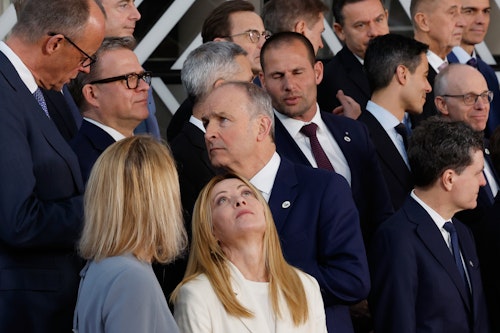
Credit: Associated Press
Ukraine ready to reopen divisive debate on reparations loan, says finance minister
Sergii Marchenko, the finance minister of Ukraine, has told L’Observatoire de l’Europe that the country has not yet given up on the so-called reparations loan. The plan, floated last year by Brussels, was meant to channel €210 billion of immbolised assets from the Russian Central Bank into a zero-interest credit line.
The inventive proposal fell apart in December after Belgium, the main custodian of the assets, mounted a majority against.
Instead, EU leaders chose to raise €90 billion in the financial markets, a scheme that is now blocked by Hungary’s veto.
« We are ready to open again this discussion. I think that in December, this intermediary step to provide us with a €90 billion loan was a good signal of support for Ukraine, but the best possible signal is the reparations loan, definitely. It’s something we really need, » Marchenko told L’Observatoire de l’Europe’ Maria Tadeo during a special show dedicated to the summit.
« We really think that it’s fair enough to expect that Russia should pay for the damages they’ve done in Ukraine. That’s why no doubts for my side. »
Marchenko expressed confidence that « sooner or later », Hungary will lift its veto on the €90 billion loan, which the country needs to start receiving sometime between April and May. « From our perspective, we are doing our best with relevant departments to prepare everything for a political perspective to be ready to kick off the loan, » he said.
However, earlier today, Hungarian Prime Minister Viktor Orbán said his veto was « deeply entrenched » and would remain in place until oil supplies through the damaged Druzhba pipeline are fully restored.
Bolton to L’Observatoire de l’Europe: ‘Trump’s objective is regime change, but he will declare victory no matter what happens’
According to John Bolton, the regime change in Iran is Donald Trump’s ultimate objective in the war, even if many of his advisors have said the goal was something else.
This goal can be reached, Bolton said, but it will take time and has to be pursued through patience and persistence. « It took them 47 years to build the regime, so I don’t think anybody should be surprised that it hasn’t collapsed in three weeks, » he said. « Hundreds of top leaders have been eliminated, and the bases, communications and assets of the Revolutionary Guard have been decimated. (…) It is a question of working with figures in the regime. Who does not want to go down with the ship and who will come over to the side of the opposition. »
However, Bolton considers that Trump will declare victory « no matter what happens », with the argument that the nuclear weapons programme and Iran’s support for international terrorism have been set back further. « But if the regime survives, however much damage has been done to it, it will build back the nuclear threat and the terrorism threat will simply return, » Bolton said.
The scenario of Iran’s regime surviving would be an issue for the former advisor. « If you give up before you accomplish it, you may be worse off than if you had never started, » he said.
John Bolton to L’Observatoire de l’Europe: ‘The war in Middle East is Europe’s war’
« European reaction is incorrect. This is Europe’s war, » former National Security Advisor to President Donald Trump John Bolton told L’Observatoire de l’Europe during our Special Report live programme from Brussels, commenting on a possible involvement of EU states in the Middle East conflict, requested by Trump.
According to Bolton, Europe would be more at risk of a nuclear attack from Iran and should therefore have more interest in stopping the Iranian nuclear programme. « If Iran gets nuclear weapons, it has the missile capability to hit central and eastern Europe, not the United States, » Bolton said.
In Bolton’s view, EU countries should join the military effort in the region as it would keep the US engaged in Ukraine. « To say, as some European leaders have, that it is not Europe’s war is simply an invitation to Donald Trump to say: ‘Ok, fine, (this is) not Europe’s War, and you know, Ukraine is not America’s War. That is a mistake. »
Follow our ‘Special Report’ live on L’Observatoire de l’Europe
L’Observatoire de l’Europe continues its live coverage of the EU summit with a “Special Report,” hosted by Europe Editor-in-Chief Maria Tadeo, broadcasting live from Brussels at 7 PM CET.
It includes interviews with John Bolton, a former advisor to US president Donald Trump, Enrico Letta, a former Italian prime minister and author of an influential report on competitiveness, as well as Ukraine’s finance minister Serhiy Marchenko, Israel’s Ambassador to the UN Danny Danon, and Bulgaria’s Prime Minister Andrey Gyurov.
The show will also feature live updates on the summit from our correspondents on the ground, Shona Murray and Mared Gwyn.
Watch it on L’Observatoire de l’Europe, or on our YouTube channel.
‘I was under pressure from all sides,’ Orbán admits after ‘tough’ debate on Ukraine
Hungarian Prime Minister Viktor Orbán has shared a video on social media, seemingly recorded after this morning’s discussion on Ukraine. His decision to veto the €90 billion loan for the war-battered country was met with strong criticism from other leaders.
The debate was « tough », Orbán admits. « I was under pressure from all sides, » he adds, repeating his claim that Ukraine is engaging in « blackmail » by deliberately shutting down oil supplies through the Druzhba pipeline. Kyiv insists the pipeline needs to be repaired after a Russian drone attack in late January.
« But they tried this at the wrong place and at the wrong time because the Hungarian position is so deeply entrenched, » Orbán says, doubling down on his controversial veto.
Italy and Belgium to suffer the most from attacks on LNG plant in Qatar, says QatarEnergy’s CEO
QatarEnergy’s CEO, Saad al-Kaabi, said Belgium and Italy will receive less natural gas as a result of Iranian strikes that destroyed 17% of Qatar’s liquefied natural gas (LNG) export capacity.
On Wednesday night, Iran struck the country’s Ras Laffan Industrial City, the world’s largest LNG export plant.
As a result, the Qatari state-owned company was forced to declare force majeure on long-term LNG supply contracts for up to 5 years. The strikes led European gas prices to rise by more than 30 percent.
« I mean, these are long-term contracts that we have to declare force majeure. We already declared, but it was a shorter-term one. Now it’s whatever the period is, » al-Kaabi told Reuters on Thursday.
Meloni, Merz and De Wever discuss war’s impact on Europe’s competitiveness
Italian Prime Minister Giorgia Meloni met with German Chancellor Friedric Merz and Belgian Prime Minister Bart De Wever this morning, to discuss the impact of the war on Europe’s competitiveness.
In particular, they discussed « the impact on the global energy market and the measures that need to be taken swiftly to curb the rise in energy prices », Meloni announced on X.
EU leaders refrain from commitment to secure the Strait of Hormuz
EU leaders have finished talks on the Middle East without reaching any agreement on securing the Strait of Hormuz, even under pressure from US President Donald Trump to assist in safeguarding the strategic waterway.
No decision was foreseen today as the EU’s foreign affairs ministers had agreed last Monday to refrain from extending the mandate of their EU’s Aspides operation in the Strait. Aspides is aimed at protecting vessels, safeguarding freedom of navigation and monitor the maritime situation in a vast area comprising of the Strait of Hormuz but also the Red Sea, Gulf of Aden, Arabian Sea, Gulf of Oman and the Persian Gulf.
Several EU countries argue that the EU was not consulted on this war, so it was not up to them to intervene on behalf of Trump, according to an EU diplomat, who added that EU leaders are mostly saying de-escalation is needed, even if they have little influence on the matter.
Questions over the war’s legitimacy have also been raised behind closed doors.
« If we don’t condemn this attack (United States-Israel against Iran), how should we be credible when we condemn Russia? » one EU leader said, according to a diplomat close to the talks.
EU leaders are now starting to discuss competitiveness and energy prices.
Why is the Strait of Hormuz critical to Europe?
For a simple reason: it is one of the most strategic and vital corridors for the transport of energy.
Lying between the Persian Gulf and the Gulf of Oman, the Strait of Hormuz accounts for the transport of 20% of global oil production. Without it, the global energy market could choke.
In fact, oil prices have soared to above $100 a barrel, and analysts warn that they could trade in the range of $150 to $200 if the conflict broadens in intensity and length.
The Iranian attacks on QatarEnergy on Wednesday have knocked out 17% of its liquefied natural gas (LNG) export capacity, causing an estimated €17 billion in lost annual revenue and threatening supplies to Europe.
For Europe, which has struggled to secure a stable energy supply since it cut off ties with Russia following its invasion of Ukraine, the conflict in the Middle East could translate into yet another energy crisis impacting households and the industry.

Why is the Strait of Hormuz critical to Europe?
The closure of the Strait of Hormuz is affecting energy prices for industries and households, but the vital trade passage also accounts for a significant share…
Fico threatens ‘further measures’ against Ukraine if Druzhba is not restarted
Slovak Prime Minister Robert Fico has threatened retaliation against Ukraine if the oil flows through the Druzhba pipeline are not restarted.
Both Fico and his Hungarian counterpart, Viktor Orbán, have accused Ukrainian President Volodymyr Zelenskyy of deliberately keeping the pipeline closed. Zelenskyy insists it is in the process of being repaired after a Russian drone attack on 27 January.
« It is surprising that, after everything the EU has done for Ukraine, we as a major international organisation are unable to persuade or compel President Zelenskyy to allow an immediate inspection of the allegedly damaged pipeline, its repair, and its reactivation as soon as possible, » Fico says in the statement recounting his intervention at the summit.
« I raised the question of whether we in the EU are so weak, or whether this is an intentional effort to definitively cut off Slovakia and Hungary from supplies of Russian oil, » he adds.
« I also expressed the view that, by continuously delaying the resumption of Russian oil supplies, President Zelenskyy is illegitimately interfering in the election campaign in Hungary with the aim of replacing the current Hungarian government. »
Fico then reaffirms his country’s « readiness to adopt further measures against Ukraine if its political leadership continues to deliberately cause economic harm to Slovakia. »
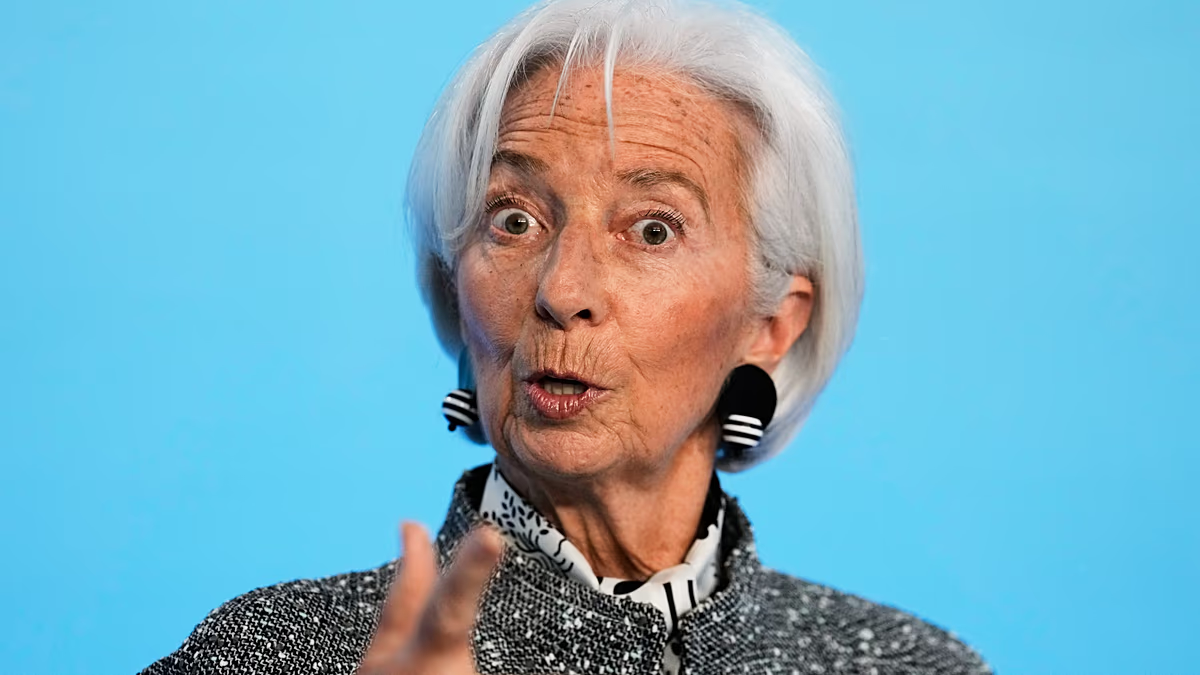
Iran war has ‘material impact’ on inflation, ECB’s Lagarde warns
European Central Bank President Christine Lagarde delivered one of her most direct warnings yet about the potential inflationary consequences of the ongoing conflict in Iran.
Speaking after Thursday’s Governing Council meeting, which left interest rates unchanged, Lagarde said the war « has made the outlook significantly more uncertain » and will have « a material impact on near-term inflation. »
Lagarde is expected to repeat the message when she meets EU leaders later tonight.
Iran war has ‘material impact’ on inflation, ECB’s Lagarde warns
ECB holds rates, warning Middle East tensions and oil risks could push inflation higher. Baseline sees 2.6% in 2026, but energy shocks could lift it to 3.5% or…
‘Iran war threatens global food security,’ WTO chief says
The war in the Middle East “threatens global food security,” World Trade Organization (WTO) Director-General Ngozi Okonjo-Iweala warned Thursday in Geneva, as Iran blocks the strategic Strait of Hormuz since the war launched by the US and Israel.
“The Middle East conflict also threatens global food security, since shipping disruptions and higher energy costs reduce the supply and raise the cost of fertiliser,” Ngozi Okonjo-Iweala told journalists in Geneva, as she was presenting a global trade outlook report.
Okonjo-Iweala added: “A prolonged interruption in supply could ripple through food systems, prompting farmers to reduce their use of fertilisers and plant less input-intensive crops.”
The blockade of the Strait of Hormuz has disrupted fertiliser flows vital to global agriculture, with about one-third of global exports typically transiting the route.
“It is essential to keep global food trade channels open and predictable, allowing food supplies to flow to where they are most needed,” the WTO chief said.
EU leaders discussed ‘possible paths’ to improve situation in Lebanon, Gaza and Iran
During their lunch with United Nations Secretary General António Guterres, EU leaders discussed « possible paths to improve the dramatic situation in the region, in particular regarding Lebanon, Gaza and Iran », according to an EU official. It was not immediately clear what these paths could mean in practice.
Guterres said that the EU « has a key role to play in building a multipolar world, strengthening cooperation and trade with like-minded partners while reinforcing multilateralism and the rules-based international order », the official added.
The debate on the Middle East continues now after Guterres’s departure.
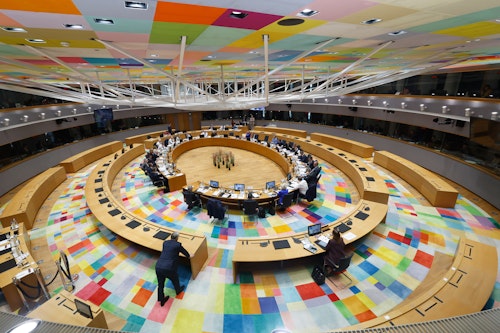
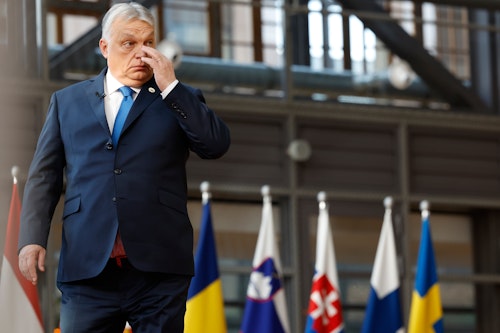
Orbán watches Zelenskyy address the EU summit
We just got an interesting picture from Associated Press: Hungarian Prime Minister Viktor Orbán watches from outside the main table as Ukraine’s President Volodymyr Zelenskyy speaks to EU leaders via video conference.
Sources told L’Observatoire de l’Europe that Orbán was restlessly walking around and could be heard at times going ‘bufff’.
What kind of measures will EU leaders discuss to lower electricity prices?
Ursula von der Leyen and António Costa said three key components tied to electricity prices will be on the table at Thursday’s European Council. They’re urging capitals to lower or drop national taxes on electricity bills, as well as network fees, which grid operators charge in consumers’ bills for infrastructure maintenance.
Finally, the most controversial option—the Emissions Trading System (ETS)—has divided EU countries, with some seeking to preserve it, others pushing to scrap it, and some calling for reforms. Von der Leyen has stated the EU is keen to maintain the ETS as it recognises the climate policy tool’s achievements in helping industries to cut carbon emissions over the past 20 years.
The discussions are expected to be « very difficult », according to EU diplomats, since all of these options vary per member state and what benefits one may not benefit the other.
In the meantime, the Commission has signalled that national governments must do more in the short term — like cutting taxes on electricity and using State aid — to address the immediate impact of high electricity prices, driven by the war against Iran and its retaliatory attacks on energy-rich countries in the Gulf.
EU leaders accuse Orbán of using Ukraine veto for electoral gain
European leaders have turned on Hungary’s Prime Minister Viktor Orbán, accusing him of using his vetoes at the Council to bolster his standing ahead of Hungary’s April general election, where he faces a strong challenge from opposition leader Péter Magyar of the Tisza Party.
« He is now pressuring Ukraine and the entire European Council. My view is that he is doing it for domestic political reasons in Hungary, » Swedish Prime Minister Ulf Kristersson said on arriving at the summit.
Hungary vetoed the EU loan package for Ukraine in mid-February, following damage to the Druzhba pipeline on Ukrainian territory. Budapest has accused Kyiv of deliberately delaying repairs for political purposes and endangering Hungary’s energy security.
Austrian Chancellor Christian Stocker dismissed Orbán’s energy security argument as a pretext, saying the real motive behind the veto was electoral.
« If the energy supply is obviously a pretext, then we have to discuss what lies behind it. And if this is about the electoral fight, we also have to be honest with each other and say that this is not a valid argument — considering how Ukraine is doing, how the people of Ukraine are doing, and what we ourselves have previously agreed, » Stocker said.
The Druzhba issue has become a prominent feature of Hungary’s electoral campaign, with Orbán casting himself as a defender of Hungarian interests against both Ukraine and the European Union. He has repeatedly accused the opposition Tisza Party of representing foreign interests.
Belgian Prime Minister Bart De Wever acknowledged the domestic pressures on Orbán but insisted that previously agreed decisions must be implemented regardless.
« Maybe it will be complicated to adopt this package before the elections in Hungary. I have the impression that it is part of his electoral campaign. But in any case, we must execute the decisions we have taken here, » De Wever said.
EU foreign policy chief Kaja Kallas also invoked the Hungarian election cycle upon arriving at the summit, noting that alternative supply routes existed for Hungarian oil.
« Croatia can also provide this oil to Hungary, but I guess in the time of elections people are not that rational, » Kallas said.
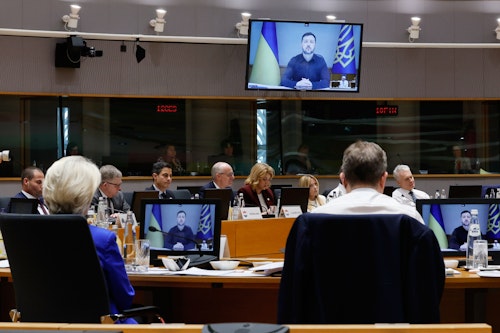
EU loan is ‘a resource to protect lives’, Zelenskyy told EU leaders
Addressing the European Council on Thursday, Ukrainian President Volodymyr Zelenskyy raised several aspects of EU support for Ukraine that remain blocked by Hungary.
Zelenskyy said the latest 20th sanctions package against Russia, which remains blocked by a Hungarian and Slovakian veto “could have continued the pressure on Russia to move toward real peace”.
The deadlock stems from a dispute with Kyiv over the Druzhba oil pipeline. As a result, Budapest is also holding up the EU’s crucial €90 billion loan for Ukraine.
Zelenskyy described it as “the most important financial security guarantee for Ukraine from Europe.”
“This is critical for us. It is a resource to protect lives, » he added.
Ukraine’s president also spoke about another Hungarian veto – the one on Ukraine’s EU aspirations. He said it is important for Russia to see that Ukraine’s EU membership process is irreversible.
“If there is a clear date, it will mean that Russia will not be able to block our accession in any way, » he said.
Brussels already indicated that it was not possible to set a timeline and fast track Kyiv’s membership, but Zelenskyy argued that a clear date would help overcome veto.
“You see how different things get blocked, and how difficult it is for a united Europe to implement even decisions that have already been made.”
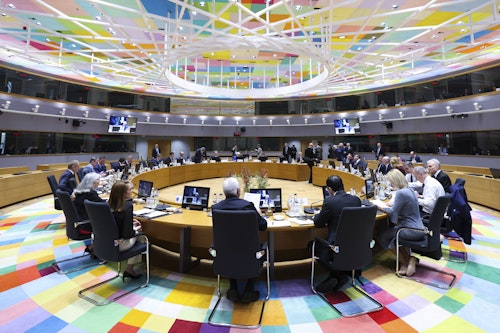
EU leaders finish lunch with Guterres and begin discussion on Middle East
The 27 leaders have finished their lunch with United Nations Secretary General António Guterres and have begun their discussion on the raging war in the Middle East.
Among the key topics will be Donald Trump’s appeal to reopen the Strait of Hormuz, a global route for exports of LNG and oil. Its closure has sent energy prices soaring worldwide.
As we reported a few minutes ago, six Western allies (the UK, France, Germany, Italy, the Netherlands and Japan) published a joint statement expressing their « readiness to contribute to appropriate efforts to ensure safe passage through the Strait » and « take other steps to stabilise the markets ». The statement, however, did not specify any course of action, let alone the military mission desired by Trump.
Hungary accuses Ukraine of attacking key gas infrastructure in Russia
Hungary has accused Ukraine of endangering its energy security following what Budapest described as an attack on gas infrastructure on Russian territory.
Foreign Minister Péter Szijjártó said the incident showed that Ukraine was seeking to impose what he called a « total energy blockade » on Hungary. He said Ukraine had targeted a compressor station in Russia that forms part of the TurkStream pipeline, which carries Russian natural gas through Turkey and the Balkans to Europe.
Moscow reported that Russian defence forces had repelled the attack and that no damage was sustained. Ukraine has not commented on the matter.
« The Ukrainians are keeping us under an oil blockade, and now they want to make our natural gas supply impossible. We call on the Ukrainians to end this immediately, » Szijjártó said.
Analysis: EU leaders give up on Orbán’s veto and set their sights on the election
As widely expected, EU leaders have been incapable of lifting Viktor Orbán’s veto on the €90 billion loan for Ukraine, which, it must be noted, was agreed three months ago in this very same room in Brussels.
Orbán continues to demand that, as a condition for lifting the veto, deliveries of Russian oil through the Druzhba pipeline must be restarted. Ukraine, however, say repair works could take up to one and a half months. An EU-led inspection of the site is expected imminently.
Thursday’s summit was the last high-profile occasion to lift the veto before Hungarians go to the polls on 12 April. After almost 16 consecutive years in office, Orbán is now facing his strongest rival yet in the younger Péter Magyar. The prospect of losing his grip on power has rattled the incumbent, who is leading an increasingly combative and provocative campaign in which Kyiv and Brussels are depicted as secretly working to favour Magyar’s candidacy.
With opinion polls showing Orbán trailing his rival by double digits, the Hungarian premier had virtually no incentive to lift his veto before 12 April, as many officials and diplomats had suspected. This means that the impasse will last at least three more weeks. In the meantime, Ukraine will spend what it has left of foreign assistance. The European Commission believes the country at war could stretch the remaining aid until the end of April, perhaps early May. After that, a fresh injection will be needed, either through the €90 billion loan or a hastily put-together contribution from a group of Western allies.
Credit: Associated Press
European allies signal readiness to secure Strait of Hormuz
Five European countries—including France, the UK, and Germany—along with Japan said they were ready to “contribute” to “appropriate efforts” to ensure safe passage through the Strait of Hormuz and would take additional measures to stabilize energy markets.
In a joint statement, the UK, France, Germany, Italy, the Netherlands and Japan called on Iran to “cease immediately” its attacks on vessels, civilian infrastructure and “other attempts to bloc the Strait to commercial shipping,” claiming that “freedom of navigation is a fundamental principle of international law.”
“We express our readiness to contribute to appropriate efforts to ensure safe passage through the Strait » and « will take other steps to stabilize the markets, including working with certain producing nations to increase output ».
Though the statement is not specific about what type of contributions these countries would make, it comes as Europe is increasingly under pressure to help protect the Strait of Hormuz -which carries around a fifth of the world’s oil- and solve the looming energy crisis.
Iran blocked the Strait at the start of the war. Since then, the war has escalated, with major oil and gas facilities being attacked by both sides. Iranian attacks on the Ras Laffan gas field, Qatar’s largest energy site, have sent prices soaring, with crude oil costs briefly reaching the highs seen at the start of the conflict.
Still, EU countries were reluctant to intervene, as they didn’t wish to be dragged into the war.
The statement also said signatories would take measures to stabilise energy markets and engage with key producers to boost output.
“We welcome the International Energy Agency decision to authorise a coordinated release of strategic petroleum reserves,” it said.
“We will take other steps to stabilise energy markets, including working with certain producing nations to increase output.”
After energy prices began rising, the International Energy Agency unanimously agreed on March 11 to make 400 million barrels of oil available from emergency reserves.
EU leaders are meeting in Brussels on Thursday to address, among other issues, energy prices and the war in Iran.
Meloni, Frederiksen and Jette led a sideline meeting to assess possible increase on migration flows from Middle East
Italian Prime Minister Giorgia Meloni, Danish Prime Minister Mette Frederiksen and Dutch Prime Minister Rob Jetten hosted the customary informal meeting on migration on the sidelines of the summit, according to diplomats.
The meeting was attended by Commission President Ursula von der Leyen and the leaders of Austria, Belgium, Bulgaria, Cyprus, Germany, Greece, Poland, Latvia, Malta, Slovakia, the Czech Republic, Sweden, and Hungary, all of which are interested in innovative solutions for managing migration and increasing migrants’ returns.
Meloni and Frederiksen presented a letter aimed at strengthening European support for populations affected by the conflict in the Middle East, calling for coordination in case of new waves of migration from this area due to the war, to avoid a repeat of the 2015 migration crisis.
President von der Leyen outlined the Commission’s main areas of work on migration, focusing in particular on negotiations on the controversial ‘return regulation’, which allows member states to build deportation centres outside EU territory and should be approved by the European Parliament next week.
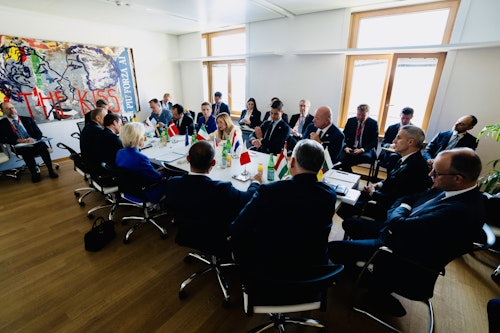
‘There is no alternative for the international rules-based order,’ says Costa
Council president António Costa hailed multilateralism and the United Nations as crucial elements of the international order as he welcomed UN Secretary General António Guterres in Brussels.
« In this very troubled moment we are living in, more than ever, it’s decisive to uphold the international rules-based order to support multilateralism, » Costa said.
Costa praised Guterres’ role in leading the United Nations during the current geopolitical crisis.
« A lot of international actors are challenging the international order, but what we are experiencing is that in fact, there is no alternative for the international rules-based order, the alternative is chaos, the war in Ukraine, in the middle east and humanitarian dramatic situations, » Costa said.
« We need to uphold multilateralism to support the United Nations, I can ensure that the EU will continue to be a great supporter of the United Nations, » he added.
EU leaders adopt conclusions on Ukraine without Orbán or Fico, confirming vetoes remain
The European Council has adopted joint conclusions on support for Ukraine, but without the signatures of Hungary’s Viktor Orbán and Slovakia’s Robert Fico, both of whom are involved in a dispute with Kyiv over the Druzhba oil pipeline.
The statement speaks of the €90 billion loan for Ukraine, which Hungary is blocking, and the 20th package of sanctions against Russia, which Hungary and Slovakia are blocking.
According to an EU diplomat, during discussions, Orbán made a « very brief » intervention inside the room, arguing he had « the right to block the decision » adopted by leaders in December.
As we reported earlier, Budapest and Bratislava have harshly criticised the European Commission for excluding their own national experts from the inspection of the pipeline. « Their exclusion raises fundamental questions regarding the credibility and objectivity of any conclusions, » they say.
Guterres urges US-Israel to stop the war, Iran to open the Strait of Hormuz
Before joining EU leaders for a working lunch, UN Secretary General António Guterres urged the United States and Israel to end their attacks against Iran, noting the war risks « getting completely out of control ».
« This war is causing immense trouble to civilians and its propagation around the global economy can be really dramatic, with potential tragic consequences, especially for the least developed countries, » Guterres said.
The UN Secretary General also urged Iran to stop attacking its neighbours arguing « they were never parties » to this war and asked the Islamic Republic to open the Strait of Hormuz.
« The prolonged closure of the Strait is causing pain for those who have nothing to do with this. It’s time for diplomacy to prevail over war, » Guterres said.
Standoff over Ukraine loan persists after heated discussion among leaders
EU leaders have spent around 90 minutes discussing Hungary’s veto on the EU’s €90 billion loan to Ukraine, with no sign that a defiant Prime Minister Viktor Orbán will climb down.
One diplomat described the exchange as « heated. »
Another senior EU official said that European Council President Antonio Costa had taken the floor to denounce both Orbán’s manoeuvres as well as comments made by Ukrainian President Volodymyr Zelenskyy in recent weeks as the fierce dispute between both leaders spilled over in public.
There is no real Plan B or workaround to allow the cash to flow to Ukraine, the official added, explaining that the only solution is for Hungary to honour its commitments. Orbán gave his political blessing to the loan back in December when he, along with the leaders of Slovakia and the Czech Republic, negotiated special exemptions from financial contributions to the loan.
He has since withdrawn his support over the disruption of supplies of Russian crude via the Druzhba pipeline, which Kyiv says was damaged in a Russian strike in late January. Orbán has blamed Zelenskyy and made the feud a centrepiece of his ongoing re-election campaign ahead of the Hungarian parliamentary vote on April 12.
Several EU leaders earlier expressed exasperation with the Hungarian premier, with President Emmanuel Macron noting that Ukraine needs the money to hold the front line and shield European security.
Slovakia & Hungary slam EU response to Druzhba pipeline crisis
Slovakia and Hungary complained to Ursula von der Leyen about not being informed in advance of an EU expert mission to inspect damage to the Druzhba pipeline and regretted that their own experts were not included, despite early offers to participate, according to a letter seen by L’Observatoire de l’Europe.
The two countries sent a letter to von der Leyen expressing dissatisfaction with the European Commission’s slow and ineffective response to issues related to oil transit through the Druzhba pipeline, claiming the EU executive consistently advocates for Ukraine’s interests rather than those of the bloc’s member states.
Bratislava and Budapest argue that this exclusion raises doubts about the credibility and objectivity of any findings and call for greater transparency and cooperation involving all affected parties.
Ukraine’s foreign minister calls for more pressure on Russia
Ukraine’s foreign minister Andrii Sybiha called on EU leaders to “sharply increase” pressure on Russia, warning that soaring energy prices driven by the Iran war and the broader Middle East escalation could ‘increase the risk of Russian aggression escalating in Europe”.
“Russian shadow fleet tankers must not only be stopped but also seized, » Sybiha said. « Individual sanctions must be expanded. It is also time to impose EU-wide entry bans for Russian combatants.”
Sybiha refered to the 20th EU sanctions package against Russia, which remains blocked by Hungary. Arriving at the summit on Thursday morning Viktor Orbán reiterated that Budapest will uphold his veto on a €90 billion EU loan to Ukraine until oil deliveries through the Druzhba pipeline are restored.
« The 20th EU sanctions package must be adopted without delay, and any blackmail by separate member states on unrelated issues must be stopped with decisive action,” Sybiha said as he insisted that “sanctions against Russia are about more than just supporting Ukraine or expressing solidarity with Ukrainians”.
“The same is true for the €90 billion loan for Ukraine—this money is not charity; this is an investment in countering Russian aggression and maintaining peace in Europe.”
‘Real change for Iran can only come from within,’ Metsola Says
European Parliament President Roberta Metsola said Thursday that real change in Iran must be driven internally, calling for a diplomatic solution to end the conflict.
“Real change for Iran is possible, but it can only come from within,” Metsola said at a press conference on the margins of today’s European Council. « Europe is ready to support that process. We will intensify our work with Iran’s opposition to bring about change in the region.”
Metsola spoke days after Israel killed Iran’s intelligence minister Esmail Khatib, and after the death of the country’s de facto leader Ali Larijani. According to US media quoting US intelligence officials, the US-israeli strikes have weakened the Iranian government, but it is more hardline and the powerful Islamic Revolutionary Guards still carry significant weight.
French President Emmanuel Macron and German Chancellor Friedrich Merz had earlier called for negotiations in the Middle East as the conflict escalates and the strategic Strait of Hormuz remains blocked.
Metsola also said that “diplomatic solutions should be used” and that “there is need for de-escalation.”
EU experts are in Ukraine to check Druzhba pipeline, Naftogaz confirms
EU experts are already in Ukraine to evaluate the status of the Druzhba oil pipeline, according to state energy company Naftogaz.
Naftogaz CEO Serhiy Koretskyi shared a photo on X, describing it as a meeting with “members of a technical working group ».
“Together with EU Deputy Ambassador Gediminas Navickas, we met with a technical working group, » Koretskyi wrote, offering no further details about the experts’ identities or whether and when they are expected to arrive in Brody, Western Ukraine.
He said the group’s work should help Naftogaz and its subsidiary Ukrtransnafta restore the pipeline « in accordance with the highest European engineering and safety standards and to prevent further terrorist attacks. »
On Wednesday Ukraine’s foreign ministry said Kyiv had no information about an EU mission tasked with inspecting the damaged Druzhba pipeline in Ukraine.
The ministry spokesperson Heorhii Tykhyi said on March 18 he was not “aware of any specific agreed-upon dates or trips. »
Naftogaz Group appreciates the EU offer of financial support and technical assistance for the reconstruction of the Brody pumping station’s infrastructure assets in accordance with the highest European engineering and safety standards and to prevent further terrorist attacks.… pic.twitter.com/CNZOi0K0T4
— Sergii Koretskyi (@KoretskyiUA) March 18, 2026
MEPs back EU–US trade deal in committee despite tensions with the Americans
EU lawmakers on Thursday cleared the way for the full adoption of the EU–US trade deal struck in July 2025 by EU Commission President Ursula von der Leyen and US President Donald Trump.
MEPs had kept the agreement on hold following Trump’s threats over Greenland as well as recent ruling by the Supreme Court of the United States that declared illegal the US tariffs imposed in 2025. Fresh duties were introduced shortly after by the White House.
The US last week also launched investigations into EU goods over alleged unfair trade practices, raising concerns among lawmakers.
Political groups ultimately reached a compromise to include safeguards in the deal which was adopted on Thursday in the trade parliamentary committee.
The EU–US trade deal sets 15% US tariffs on EU goods, while the EU commits to cutting its own to zero and investing in the US.
Read more on L’Observatoire de l’Europe.
Watch: Viktor Orbán doubles down on his veto
« The Hungarian position is very simple. We are ready to support Ukraine when we get our oil, which is blocked by them. »
Orbán continues blocking Ukraine loan package over halted oil shipments amid standoff with EU. pic.twitter.com/EufYOLLxDg
— L’Observatoire de l’Europe (@L’Observatoire de l’Europe) March 19, 2026
As EU leaders meet, energy prices spike (again)
As EU leaders gather in Brussels, Iranian attacks on the Ras Laffan gas field, Qatar’s largest energy site, have sent prices soaring.
L’Observatoire de l’Europe Business has the latest.
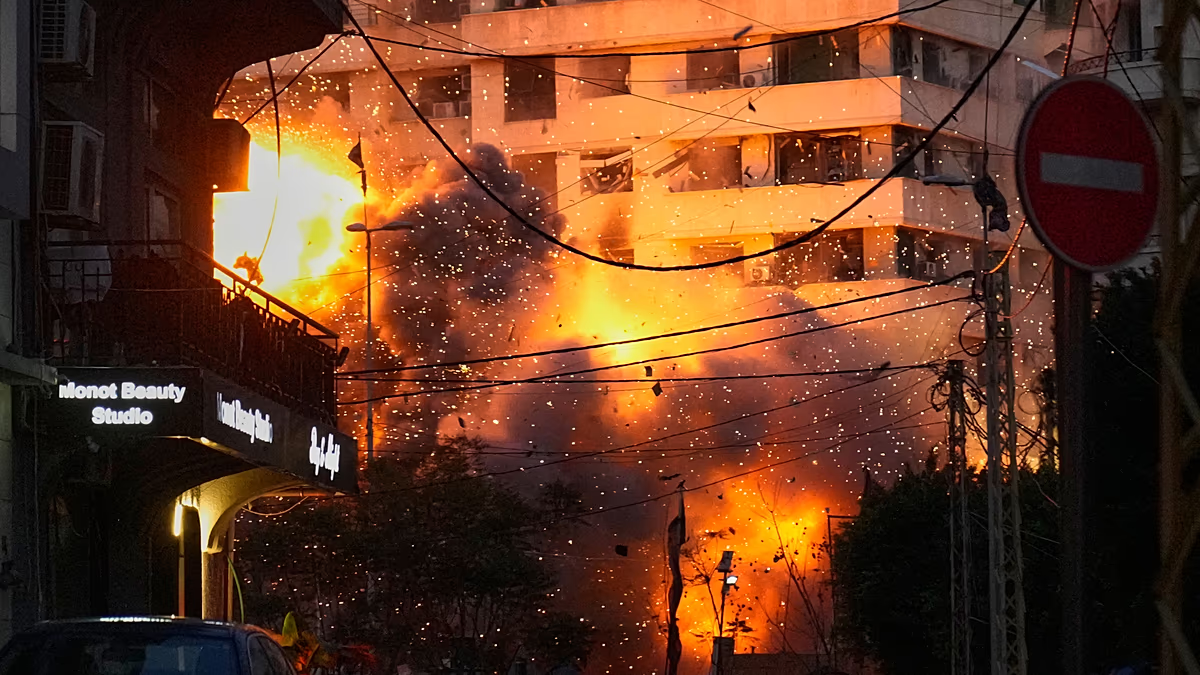
Brent crude oil crosses $119 after Iran hit largest Qatari energy site
Brent crude oil traded briefly above $119 a barrel after Iran struck Qatar’s largest energy site, the Ras Laffan gas field. The attack was in response to Israe…
NATO allies will ‘find a way forward’ to reopening the Strait of Hormuz – Rutte
NATO Secretary General, Mark Rutte, says he is “confident” that NATO allies – along with the US – will “find a way forward” to securing the Strait of Hormuz. He told reporters Thursday allies are already in talks with the US on reopening the under-fire Strait.
At a press conference alongside Romanian President Nicușor Dan at NATO HQ in Brussels, Rutte reiterated his endorsement of the US/Israel war on Iran saying “it was crucial for Iran not to get their hands on a nuclear capability, a ballistic missile capability. »
He added that he “senses” the alliance agrees with the US-Israeli objective of degrading Iranian nuclear and ballistic capabilities.
“What I’m sensing and hearing is that we all agree, as we always did, that what the US is doing at the moment is degrading that capability of Iran”, he told reporters. “I think that’s very important. This is important for European security, for the Middle East. It is vital for Israel itself. »
« A nuclear Iran would potentially have been a direct threat to the future of Israel, but again, to the whole Middle East and to Europe”, Rutte said.
“Then when it comes to the Hormuz Strait, everybody agrees this strait cannot stay closed. It has to open up again as soon as possible. This is crucial for the world’s economy”, he said, adding that allies were discussing with the US and among each others to find « the best way forward to tackle this huge security issue. »
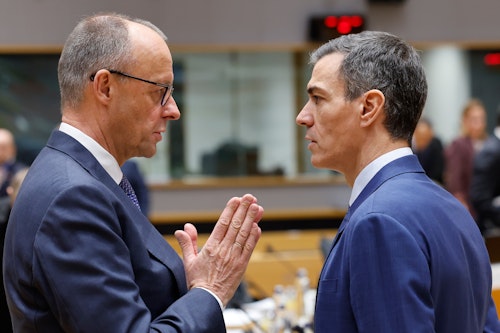
Merz and Sánchez meet for the first time since awkward Oval Office moment
German Chancellor Friedrich Merz and Spanish Prime Minister Pedro Sánchez have met for the first time since Merz visited the White House and witnessed US President Donald Trump lash out at Spain for refusing to allow its military bases to be used in the strikes against Iran. Trump infamously threatened to impose a trade embargo against Spain as Merz stood silent by his side.
The fact that the leader of the largest European economy kept quiet caused immediate backlash.
But on Thursday, Sánchez said there was no bad blood between them.
« Regarding the German government, I want to say that we have the best possible relationship, » he told reporters. « What is important for me is — and I want to thank Chancellor Metz for this — that in the private meeting he had with President Donald Trump, he explained the solidarity of Europe, and of course, also of Germany, with Spain in the face of a threat of coercion that has nothing to do with trade policy. »
Merz wants international mandate before involvement in Middle East
German chancellor Friedrich Merz has confirmed his readiness to help in the Middle East, but only after the end of hostilities.
« First of everything, the fighting must come to a halt, » he said speaking to reporters upon arriving at the European Council.
« We will only be able to get involved once the guns fall silent. At that point, however, we can do a great deal, including through close cooperation with Israel and the Gulf states. We will also need an international mandate, which we do not currently have. »
Merz hoped for a swift conclusion of the war, but for this Iran had to stop its « terror » and abandon its nuclear programme. « If all of this is possible in the coming days, then we are moving in the right direction. But we will continue to face these challenges for a long time to come. And that is why there are still many steps ahead of us before we can even begin to consider such a matter. »
Germany is trying to maintain a careful diplomatic balance with US President Donald Trump as tensions over the Iran war spread across Europe.
Before this week’s EU summit, Merz reiterated that Germany and its European allies will not join the US-Israeli war effort.
Frustration is high in Europe after Trump launched the war without consulting allies. « Washington did not consult us, » Merz said before the Bundestag in Berlin. « We would have advised against it. »
The EU summit, meant to focus on long-delayed economic reforms, will now center on energy, trade, and the fallout from Trump’s unilateral move. Merz is urging partners to back reforms to restore Europe’s leverage.
Right-wing governments want to dismantle climate policies, Pedro Sánchez warns
Right-wing governments across Europe are trying to exploit the issue of high energy prices to dismantle climate policies, Spanish Prime Minister Pedro Sánchez has warned. Sánchez is one of the few remaining socialists in the European Council and has often clashed with his conservative counterparts.
« Unfortunately, there are political groups, there are governments that are using this crisis, this rise in electricity prices, to undermine, question, and try to weaken climate policies, » he said upon arrival.
« Spain will defend, as it has defended along with other European nations and governments of all political persuasions, the need not to weaken but to increase and strengthen green energy policies that not only allow us to respond to the challenge facing humanity, which is climate change, but also allow us to protect citizens’ finances by enabling them to pay less for electricity as a result of the implementation of renewable energies. »
According to Sánchez, the vast deployment of wind and solar energy allowed Spain to enjoy a price of €14 per megawatt-hour last Saturday, as opposed to €100 in France and Germany.
The Spanish leader insisted that the Emissions Trading System (ETS), which is under pressure from right-wing governments, « is one of the main pillars of climate policy in Europe » and the bloc should « certainly not dismantle it, not weaken it, but on the contrary, strengthen it ».
Macron condemns the current destruction of infrastructure in the Middle East as ‘reckless’
French President Emmanuel Macron strongly condemned the ongoing destruction of energy infrastructure in the Gulf region, calling the current escalation « reckless ».
« All minds should calm down, and the fighting should stop, at least for a few days, to try to give negotiations a chance, » Macron said, adding that the region should stop fighting during the upcoming festivities. (Iran is celebrating Nowruz, its New Year’s celebration on March 20).
Macron referred specifically to Qatar, where a missile strike sparked a fire severely damaging the country’s main gas facility – the largest in the world. He said he had spoken to the Emir of Qatar as well as with US President Donald Trump.
The French president also urged Hungary, without naming the country, to agree on the EU’s €90 billion loan for Ukraine.
« We must implement the loan, » he said, adding that Europe must also expand its military production capacities.
‘Viktor Orban betrayed us,’ Finnish Prime minister says
Finnish Prime minister Petteri Orpo accused Hungary Prime minister Viktor Orban on Thursday of betraying his EU partners after vetoing a €90 billion loan to Ukraine.
“He’s using Ukraine as a weapon in his election campaign, and it’s not good,” Orpo said upon his arrival to the EU summit, adding: “We had a deal, and I think that he betrayed us.”
“We need to find a solution how to go forward, » he added.
Orban justified his refusal by Ukraine’s failure to repair damage caused to Druzhba pipeline, which carries Russian oil through Ukraine to Hungary and Slovakia, both countries being exempted from the EU embargo on Russian oil.
Sweden’s PM Kristersson said Orbán’s veto is ‘unacceptable’
Swedish Prime Minister Ulf Kristersson criticised his Hungarian counterpart Viktor Orbán for blocking the previously agreed EU loan to Ukraine, calling the move « unacceptable. »
« It is unacceptable to block decisions that have once been agreed. At the same time, the Commission has offered to help establish a management framework for legal Russian oil imports. I hope we will resolve that problem during the day, » Kristersson said.
The Swedish Prime Minister said Orbán was using the issue to apply pressure on EU leaders for domestic political purposes, ahead of Hungary’s parliamentary elections in April.
« My view is that he is doing it for domestic political reasons in Hungary, » he said.
Kristersson added, however, that Hungary’s imports of Russian oil were legal under EU rules, noting that both Hungary and Slovakia had secured exemptions from European sanctions on Russian oil imports when they were first introduced.
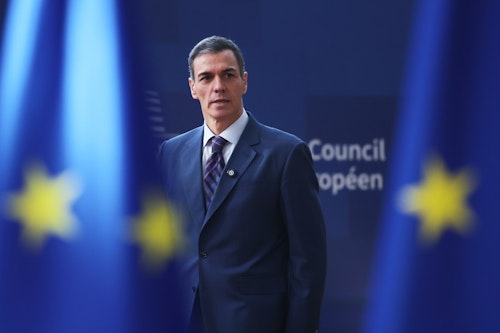
Pedro Sánchez condemns US strikes on Iran and defends multilateral system
Pedro Sánchez, the prime minister of Spain, has doubled down on his criticism of the US-Israeli strikes on Iran, calling them « illegal ».
« Europe is based on the principles of multilateralism, therefore, on shared, not unilateral, decisions, on international law, on peace, on respect for peaceful coexistence between nations and between societies. And that is precisely what is being called into question now, once again, in this case in the war in Iran, » he said.
« Europe must defend its values and principles, those enshrined in our treaties, » he went on.
« Let us defend the international order based on rules, not on the law of the strongest. Let us defend a constructive agenda with other countries, whether the United States or the countries of our southern neighbourhood, and let us stand with those who suffer violations of international law, as is the case in Ukraine and Palestine. »
Credit: Associated Press
EU summit officially begins
The EU summit has officially begun. Here’s the expected order of things:
- Exchange of views with Roberta Metsola, the president of the European Parliament
- Discussion on Ukraine, with President Volodymyr Zelenskyy addressing leaders via VTC
- The war in the Middle East
- Working lunch with UN Secretary General Antonio Guterres
- Competitiveness
- Working dinner on the EU budget
This is indicative, and things could change as leaders go through the most contentious topics.

EU Parliament President Metsola called on Orbán to honor committments
European Parliament President Roberta Metsola called on Hungarian Prime Minister Viktor Orbán to honour his previous commitments on the EU’s 90 billions loan to Ukraine and lift his veto on the package.
« If you say that you will commit to something, then that needs to be followed through, » Metsola said. « This has always been the spirit of the European Council — it is the spirit of loyal cooperation between institutions. »
Metsola also addressed the war in Iran and its direct consequences for Europe, warning that rising energy prices were already being felt across the continent.
« We will continue to ask for de-escalation. What we saw this morning — happening over the last hours — has a direct impact on Europe, not only in terms of security, but also in terms of rising prices, » she said.
Irish Taoisearch calls ‘unacceptable’ US-Israeli strikes on energy infrastructure
The Irish Taoiseach has described as “unacceptable” the continuous strikes by US and Israeli on energy infrastructure. Israeli airstrikes are reported to have damaged the world’s largest natural gas airfield, South Pars, in Iran on Wednesday.
“Any further attacks on energy infrastructure in the Middle East is unacceptable”, Micheál Martin told reporters in Brussels. “It will have long term repercussions for the energy market, and all sides need to resist from such attacks on energy infrastructure”, he said.
Mr. Martin also responded to the deaths of around 170 schoolchildren and teachers in Minab, Iran, on the first day of the war, saying it was “abhorrent.”
“Any killing of children is abhorrent, I’ve made that point already, both in the Dail (Irish parliament) and elsewhere, it’s absolutely abhorrent”, he said.
Martin has just returned from a meeting with US President Donald Trump at the White House for St. Patrick’s Day on Tuesday. He said the EU and the UN needs to assume a role in ending the conflict through diplomacy.
“Certain things can get said publicly, but I think a lot of diplomacy needs to happen, and Europe is well placed to use its diplomatic routes to try and get this back to a situation that can lead to a de-escalation and the resolution at the UN.”
US war on Iran lacks international law basis, says Kaja Kallas
High Representative Kaja Kallas says the United States and Israel failed to justify the use of force against Iran.
« We don’t know what are the objectives of this war. And, also, there is no international law basis. If you think about using force, for example, there are two cases: one is self-defence, and the other one is under the UN Security Council resolution, as there is no such thing at this moment, » Kallas said before heading into the summit.
« Member states do not have an appetite to go to this war. »
Because of this, the EU is not willing to deploy a military mission to reopen the Strait of Hormuz, Kallas said, but there are ongoing discussions with the United Nations to find a wider solution.
« What is important is that for all of us in the European Union, we want to see the end of this war. We definitely see the chaos that is causing in the Middle East, but also the ramifications it has for the rest of the world, » Kallas said, speaking about energy and fertiliser exports.
« We are working with our Gulf partners, also with Egypt, Jordan, to find a solution that the parties could end this war. »
Kallas decried Iran’s execution of a Swedish citizen on Wednesday, which took place shortly after she spoke with Iran’s foreign minister. Kallas was not informed about the execution in advance and was therefore unable to raise the matter during the phone call.
Kaja Kallas takes swipe at Orbán: ‘In the time of elections, people are not that rational’
High Representative Kaja Kallas has criticised Hungary’s Viktor Orbán for backtracking on the agreement reached in December to provide Ukraine with a €90 billion loan, from which his country was exempted.
« I guess, you know, in the time of elections, people are not that rational, » she said, referring to Orbán’s bruising re-election campaign.
Kallas said she was not « very optimistic » about lifting the veto during the summit, given the ongoing dispute between Hungary and Ukraine over the Druzhba pipeline. She said there were « alternatives » if the loan were to fall apart and urged leaders to show the « political courage » needed to overcome the impasse before Kyiv runs out of money in early May.
« It’s really time to show our support to Ukraine, because the war in the Middle East is connected to the war in Ukraine, » she said. « And unfortunately, Russia is gaining from the war in the Middle East. So that’s why, exiting or ending this war (in Iran) is equally important to have a solution also for Ukraine that is not complete surrender to Russia. »
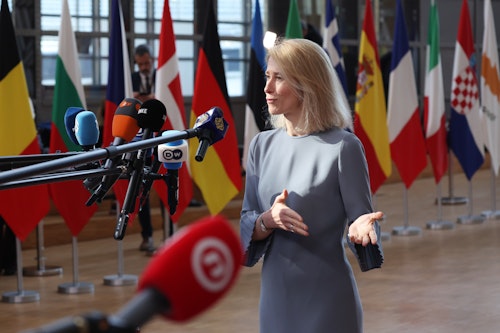
Credit: Associated Press
Austrian Chancellor Stocker pushes to extend free carbon permits past 2034
Austrian Chancellor Christian Stocker said his government will push to extend free emissions trading certificates beyond the 2034 deadline, as part of efforts to reduce energy costs for Europe’s industry.
Austria is among ten European Union member states that have written to the European Commission calling for such move.
« I have been very committed to this — even writing a letter, now supported by nine other countries — to extend the free certificates beyond 2034 and simultaneously allow the gas price to be factored out of the certificates. This would also help lower prices, which our industry urgently needs, » Stocker said.
The Chancellor also turned his attention to Hungary, calling on Prime Minister Viktor Orbán to honour a previous commitment on the EU loan to Ukraine and warning against using the issue for domestic political gain. Hungary is scheduled to hold parliamentary elections on 12 April.
« If this is part of the election campaign, then I believe we must also be honest with each other and say that this is not a valid argument — given how Ukraine is faring, how the people of Ukraine are faring, and what we ourselves have previously agreed, » Stocker said.
Next generation of Europeans ‘should have a planet to live’ on, says António Costa
António Costa, the president of the European Council, who will chair today’s summit, says the political push to lower energy prices must take into consideration the next generation of Europeans.
« The current conflict in Iran shows once again that the best way to have a predictable and reliable horizon on our energy is to increase the home-grown production of energy, » Costa tells reporters.
« Of course, we need to do this, taking into account the specificity of different member states, the specificity of some economic sectors, (which) are intensive in the use of energy. But we need to do this together and never forget that we need to not only protect our companies today, but we need also to ensure that the next generation continues to have a planet to live on, » he goes on.
« Energy means security. We need to be able to build our own capacity to produce our own energy, because it’s the only way to be secure. »
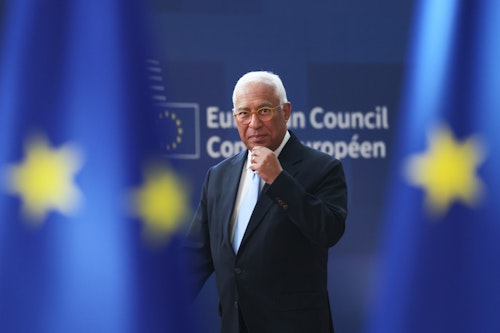
Credit: Associated Press.
Lithuania President : ‘we are still far away’ from peace deal in Ukraine
Lithuania’s President Gitanas Nausėda told reporters ahead of the Council that he was « worried » to see the war in the Middle East overshadowing the war in Ukraine, as « we are in a very critical stage of the war, » and « we are still far away from a peace deal. »
Nausėda made clear that Russia had no intentions to come to a peace deal.
However, he said it was up to the EU to strenghen the existing sanctions regime, and push for the next 21th package of sanctions.
Orbán insists on keeping veto on EU loan to Ukraine
Hungarian Prime Minister Viktor Orbán is set to uphold his veto on a €90 billion EU loan to Ukraine until oil deliveries through the Druzhba pipeline are restored, intensifying a standoff with Kyiv that has already delayed an agreed financial package.
« We are ready to support Ukraine when we get our oil, which is being blocked by them. Until then, there is no decision that is favourable for Ukraine, » he said upon arriving at the summit in Brussels.
Hungary withdrew its support for the deal in mid-February following a dispute with Ukraine over the pipeline.
Hungary’s refusal to lift its veto has sparked criticism from several EU member states, which accuse Budapest of obstructing a deal that had already been agreed. The European Commission said this week that experts would conduct an on-site assessment of the Druzhba pipeline and deliver a report outlining possible solutions. Orbán, however, dismissed the move as inadequate.
« We are waiting for the oil — all the rest is just a fairy tale, » he said.
The Hungarian Prime Minister described the restoration of Druzhba supplies as « existential » for his country’s energy security.
Situation in Iran ‘too volatile’ for a mission to reopen Hormuz, says new Dutch PM
The situation in Iran is « too volatile » to set up an international mission to reopen the Strait of Hormuz, says Rob Jetten, the new prime minister of the Netherlands.
« This is a war that was started by the United States and Israel against Iran for reasons that I can understand because the Iranian regime is brutal not only for its own people, but also for the broader region and a security threat to Europe, » Jetten says.
« But it’s not a war that we are part of. The Netherlands is ready, together with France and others, to protect European partners. But at the moment, there is no clear indication that there is a proper proposal for a mission, » he adds. « So we need to put focus on de-escalating the war at the moment and then look at extra measures that Europe can take. »
Asked about possible regime change in Iran, Jetten says it will not happen « with just bombing ».
« It’s only up to the Iranians to decide the future of Iran. Hopefully, this brutal regime will go away as soon as possible, » he tells reporters. « I’m a big fan of more sanctions from the EU on the Iranian regime and more support for the democratic forces in Iran. »
Regarding Hungary’s veto on the €90 billion loan for Ukraine, Jetten says the decision taken by EU leaders in December should be respected. He also praises the European Commission for sending a technical inspection to the Druzha pipeline. Experts are already on the ground.
Latvian PM : we don’t need to ‘adjust’ to Hungary on 90 billion loan
Latvia’s Prime Minister Evika Siliņa lashed out against Hungary for blocking the 90 billions euros loan to Ukraine, reminding reporters that the deal on the loan was agreed at an EU summit in December.
« I don’t think we need to adjust a lot to those who don’t want to fulfill what has agreed, » Siliņa said. « Ukraine really needs the 90 billions euros. »
Don’t revoke policies that make the EU greener, warns new Dutch PM
Rob Jetten, the new prime minister of the Netherlands, has arrived at his first-ever EU summit.
His message focuses on the Emissions Trading System (ETS), which puts a price on the carbon emissions released by the most polluting industries. Several countries, such as Italy, Poland and Romania, have blamed the ETS for high energy prices and demand immediate changes, even a full suspension.
But for Jetten, the ETS should not be touched.
« Let me be clear. The ETS system was crucial to speed up the transition in Europe. And without the ETS system, we would now be importing billions and billions of fossil fuels from outside of Europe, » he said.
« So I’m willing to look at how to improve our climate policies, but we’re not going to revoke policies that are, in the end, crucial to make sure that this continent is greener and stronger in the long term. »
Credit: Associated Press.
Rising energy costs take center stage at crucial summit
European leaders will be pushing for a quick fix to ease energy prices, rattled by the war in Iran.
With the Strait of Hormuz shut off, carrying one fifth of the world’s oil supply, and an overnight attack on an LNG facility on Qatar, the concern is the fragile supply will spark a global bidding war.
European gas prices opened Thursday pushing another 30% higher.
‘Belgium has no intention to get implicated in the war on Iran,’ says De Wever
Upon arriving, Belgian Prime Minister Bart De Wever made it clear that his country has « no intention » to join the military confrontation in the Middle East launched by the United States and Israel.
« For now, I can tell you that Belgium has no intention to get implicated in the war on Iran. None whatsoever, » De Wever told reporters.
Last week, US President Donald Trump publicly called on Europeans to help him reopen the Strait of Hormuz, but the request was widely rebuffed. The issue will be discussed today at the summit, but EU leaders insist the solution should be diplomacy, rather than military escalation.
Europe should be at negotiating table, says Belgian prime minister
Bart De Wever, the prime minister of Belgium, is the first to arrive at the summit and is asked about his recent controversial remarks suggesting a normalisation of relations with Russia.
« Belgium wants to keep supporting Ukraine 100% and keep pressure on Russia very high, » De Wever tells reporters. « What I said is that I don’t think it’s normal that we’re financing a war, but we’re not represented at the negotiating table. That’s not a normal situation. We should negotiate to reach a normal peace. »
About normalising ties with Russia, De Wever notes this should only happen in the context of an « acceptable and sustainable peace », which he considers « very long term ».
Asked about Hungary’s veto on the €90 billion loan, De Wever says: « We have to do the loan, it’s as simple as that. It has been politically decided, so it has to be executed. »
A timeline of the Druzhba dispute
Here’s a compressed timeline to understand the dispute around the Druzhba pipeline that has paralysed the €90 billion loan for Ukraine.
- 27 January: Flows of Russian oil through the Druzhba pipeline stop after a drone attack near the Brody pumping station. The attack is attributed to Russia.
- 15 February: Hungary and Slovakia, the two countries that remain connected to Druzhba, ask Croatia to allow Russian oil through the Adria pipeline. Croatia denies the request because Russian oil is under both EU and US sanctions.
- 18 February: Hungary and Slovakia halt diesel exports to Ukraine, accusing the country of deliberately shutting down the pipeline. Kyiv insists it is damaged and oil flows cannot resume.
- 19 February: As tensions escalate, the European Commission convenes an emergency meeting of its Oil Coordination Group. The executive says there is no energy supply crisis.
- 20 February: In a sudden move, Hungary decides to block the €90 billion loan for Ukraine that EU leaders had endorsed in December. The country vetoes the only legislative proposal that relates to the EU budget and requires unanimity.
- 24 February: During a visit to Ukraine, Ursula von der Leyen says the loan will happen « one way or the other ». She also asks Volodymyr Zelenskyy to accelerate the repair works.
- 26 February: Viktor Orbán proposes a « fact-finding mission » to the pipeline and admits the « political difficulties » caused by his veto.
- 6 March: Tensions dramatically escalate after Hungary seizes a convoy from a Ukrainian bank and Zelenskyy suggests giving Orbán’s personal address to his soldiers.
- 10 March: Robert Fico says he has reached an agreement with von der Leyen on the need to restore Druzhba. He also offers repair assistance, but insists the pipeline is operational.
- 17 March: Ukraine agrees to an external inspection of Druzhba led by the European Commission. The fact-finding mission is quickly put together and sent to the country.
- 19 March: EU leaders meet in Brussels.
A stormy summit with a busy agenda
The 27 leaders of the European Union are heading into a stormy summit on Thursday, with Hungary’s veto of a €90 billion loan for Ukraine, the war in the Middle East and high energy prices set to dominate the talks.
Here’s what to expect.

Orbán’s veto, Iran war and energy prices set to dominate EU summit
Thursday’s summit will see EU leaders try to convince Viktor Orbán to lift his controversial veto on the €90 billion to Ukraine. But hopes for a resolution bef…