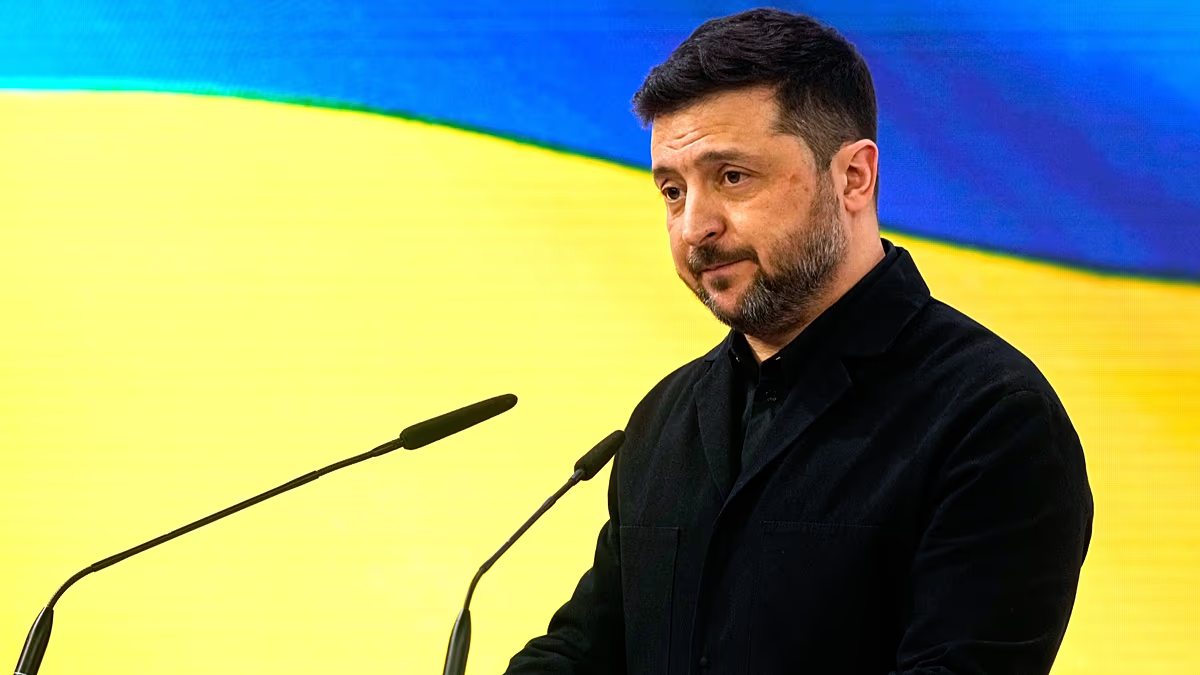
Catch up on what happened during the second day of the 2026 edition of the Munich Security Conference where Marco Rubio, Volodymyr Zelenskyy, Ursula von der Leyen, Keir Starmer and many more leaders took to the stage.
Volodymyr Zelenskyy on Saturday told the European Union from the Munich Security Conference that Ukraine « needs a date » for its accession and aims to be ready to join in 2027, in response to a L’Observatoire de l’Europe question.
« We need a date, » he said during a press conference. « The date of accession depends on all these talks with partners but, and I don’t want to be disrespectful to the United States and Europe, we need a date because otherwise Russia will try to block us – directly or through maybe other countries. »
« Ukraine has to be technically ready to join 2027, my government, the parliament, the institutions. »
The other big draw of the day in Munich was US Secretary of State Marco Rubio who said in his eagerly-anticipated speech that Washington wants to « revitalise » its relationship with Europe and that the two blocs should fix what he described as a « broken » status quo together.
But he still stuck to US government lines that the rules-based international order birthed after WWII infringed on sovereignty, and led to mass migration which in turn destabilised Western countries.
Plenty more world leaders took to the stage, including European Commission President Ursula von der Leyen and Danish Prime Minister Mette Frederiksen. Scroll down below to catch up on what they said.


${title}
Live ended
That’s wrap from us!
Our live coverage from the Munich Security Conference is coming to an end and what a wild ride this has been!
What were the key messages?
- From Europe, leaders were keen to stress that they have heard the US and they have started the work to step up and take more of the responsibility for defending the Old Continent;
- From Volodymyr Zelenskyy, it was that Europe should be at the peace talks and further tighten the noose around Russia’s economy;
- From the US, it was that the Western ‘civilisation’ is coming under attack and that both sides of the Atlantic should work together to save it.
We will have further coverage from the conference tomorrow, including a wrap piece on what you must absolutely remember from this year’s conference, so watch out for that. If you simply cannot wait for it, scroll back for a blow-by-blow of the day’s event. Yesterday’s as-it-happened blog can be found here.
Enjoy your evening!
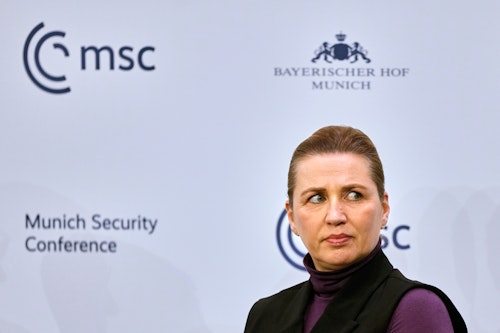
Frederiksen on Russia’s ‘Imperial ambitions’
Danish Leader Mette Frederiksen has rounded off the Q&A comparing Russia’s ambitions in the Arctic to Russia’s war in Ukraine.
« It’s about Russia’s imperial dreams, and the same goes for the Arctic region. This is not about the Arctic region, it’s about Russia’s imperial dreams. The hybrid war against Europe that is going on every day has to be tackled at the same time as the war in Ukraine and the Arctic. »
« There are two very important lessons learned. As Europeans, you cannot build your strategy on what other people are doing. So was there like a European moment this January? Yes, there was. And now our obligation is to transform that Greenlandic European moment into a European strategy, » she concludes.
Credit – AP
Nielsen: ‘The pressure on us is unacceptable’
Greenland’s Prime Minister has addressed Trump’s claims on the island, striking both a humourous and dramatic tone.
« I don’t think its an elephant in the room anymore. He’s pretty transparent and has been for fourteen months, » he says on Trump’s demands on the island. The US President has repeatedly said that he needs Greenland for US national security and offered to buy the island.
« If I think about my people, we are so proud. We live in a harsh environment. We are resilient. We live in a land where nobody were able to live for many, many, many years. There’s a reason why we are the ones left, » he says to laughter in the audience.
« This is not only about Greenland. Imagine a NATO country acquiring, taking, threatening an ally. Where would the world stand if that happened? ..It’s outrageous. »
Asked about the trilateral talks currently ongoing between Greenland, Denmark and the US, and whether he sees their outcome as successful Jens-Frederik Nielsen said: « we need to take the right step and the first right step is to have a dialogue between us. »
« But we cannot lower our shoulder. The desire to control or to have Greeland is there but I think we are taking the right step, » he also said. He also said he acknwoledges the « big issue » for the US is security.
On that, he said, Greenland is ready to do its part and is « committed to be part of the alliance ».
Canada launched procurement for more Arctic capabilities years ago – Anand
Since the start of the war in Ukraine, Russia has moved some of its infrastructure further north, Canada’s Foreign Minister just said, calling for more cooperation in the Arctic in both capabilities and diplomacy.
Anita Anand said that given that 40% of Canada’s land mass « interfaces with the Arctic », the country has not waited until today to invest and has over the past few years, invested in infrastructure and launched procurement for over-the-horizon radars, icebreakers, for the modernisation of NORAD (the North American Aerospace Defence Command) to boost aerial surveillance.
« We need to all acknowledge the changing global threat environment and the importance of supporting each other, collaborating with each other in terms of our capabilities in the Arctic and our diplomacy in the Arctic, » she said.
The Greenlandic perspective: Nielsen prepared to ‘take greater responsibility’ for island’s security
We are now turning back to a panel titled « Spotlight on Arctic Security » featuring Danish Prime Minister Mette Frederiksen, Greenlandic leader Jens-Frederik Nielsen and Canada’s Foreign Affairs Minister Anita Anand, among others.
Nielsen says the island has experienced peace and low tension for many years, but that it recognises there are no longer any low-tension regions in the world.
He said Greenland is prepared to take greater responsibility for surveillance and security in its region and work closely with Denmark on these issues.
« It’s very important for me to say that the … NATO alliance is something that we are truly committed on as Greenlanders, » he concludes.
Sikorski on Poland’s response if Russia invaded
Poland’s Sikorski ends the panel with his response if Russia invaded Polish territory.
« If they cross the border, start killing Nato citizens, Polish citizens, we would expect the North Atlantic Council to meet and to activate the contingency plan, and after that, the plan is very easy: we win, they lose.”
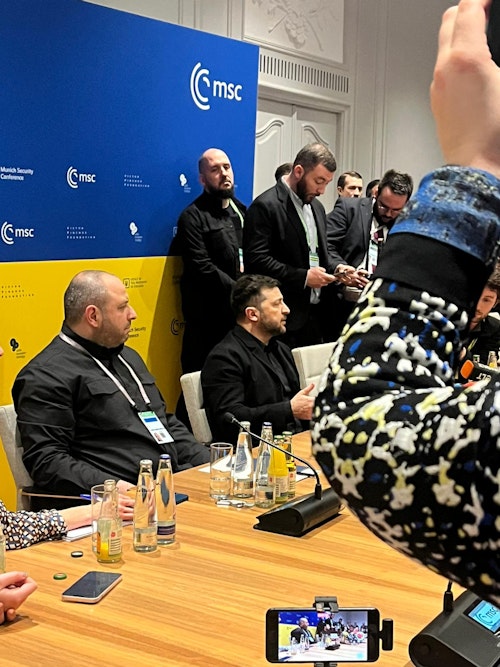
Ukraine ‘needs a date’ for EU accession, plans for 2027 – Zelenskyy
Volodymyr Zelenskyy just said in response to a L’Observatoire de l’Europe question that Ukraine « needs a date » for its accession to the European Union and that he aims to be ready to join in 2027.
« We need a date, » he said during a press conference. « The date of accession depends on all these talks with partners but, and I don’t want to be disrespectful to the United States and Europe, we need a date because otherwise Russia will try to block us – directly or through maybe other countries. »
« Ukraine has to be technically ready to join 2027, my government, the parliament, the institutions.
Sikorski: Stakes are ‘incredibly high’
Polish Foreign Minister Radosław Sikorski has reminded the panel about the stakes of Russia’s invasion of Ukraine.
« Because the stakes are incredibly high. It’s not just the future of Ukraine, it’s not just the security of the eastern flank — it is about the place of Europe in the future distribution of power in the world. In other words, who will be the third leg of global power: China, the United States, and Russia, or the European Union? Don’t ask me which I would prefer, » he says.
« And to my mind, President Donald Trump is not wrong when he says that in this more brutal world, you need to show your cards. The United States would give itself more cards to pressure Putin into a deal by, for example, delivering Tomahawks to Ukrainians. That decision was apparently quite close a couple of months ago, » he continues.
Europe deserves a seat at the table because it’s paying for Ukraine’s defence: Polish FM
Polish Foreign Minister Radosław Sikorski just said that Europe deserves a seat at the negotiating table because, unlike the US, it is paying for Ukraine’s security.
« American outlay for the war last year was close to zero, » Sikorski said while taking part in the « Holding the Line: Defending Europe and Supporting Ukraine » panel.
« We are buying American weapons to be delivered to Ukraine. There is no package in the US Congress and there isn’t even the prospect of a package. If we are paying, if this is affecting our security, not just Ukraine’s, then we deserve the seat at the table because the outcome of this war will affect us, » he said.
Lithuanian President Gitanas Nauseda also said Europe should have a seat at the table but that it’s being kept away because Russia doesn’t want that and « Washington lets that happen ».
« We can’t push ourselves at the negotiation table when Putin is not willing to talk with us and Washington is willing to let that happen, » he said. The next best thing Europe can do, he added, is to reiterate all the time that it will continue supporting Ukraine.
‘Whole districts’ have no water, no heating, no electricity – Ukrainian Deputy PM
Ukraine’s Deputy Prime Minister for European and Euro-Atlantic Integration Taras Kachka is taking part in the « Holding the Line: Defending Europe and Supporting Ukraine » panel where he opened by talking about the dire energy situation in the war-torn country.
« We will repair our energy till the moment we will have stocks for equipment, » he said, adding that « Russia attempts to destroy the energy system to the level it is not repairable ».
He said that a lot of people throughout Ukraine have no heating, electricity or water amidst sub-zero temperatures.
« Life in Kyiv, if you want to have a hot tea, you have to wake up at 3am when you have electricity, » he said, noting though that elsewhere there are « whole districts where you have nothing at all ».
He urged partners to give missiles that can be used with the various air defence systems Ukraine has – including Patriots, SAMP-T, and IRIS-T – saying that if they have enough stocks « we’d be able to intercept » Russian missiles aimed at energy infrastructure.
The ball is in Putin’s court, Pistorius says, as he claims NATO is changing for the better
Germany’s Defence Minister Boris Pistorius says “the ball is in Putin’s court” over Moscow’s full-scale invasion of Ukraine.
According to him, NATO is becoming “more European so that it can remain transatlantic.” He adds that US funding for the alliance was always meant to be an exception, never the norm.
Europeans, he says, have done “too little to support precious order — when we dwelled on our weakness, when we complained, when we criticised each other for inaction.”
“The reality today is very different. Combined European armies outnumber any other army in the world. We are spending much more on defence than ever before. Our defence industry produces top-tier equipment. We are taking our future into our own hands in the areas of joint capability development and procurement financing.”
He also says Germany’s and Europe’s defence policy needs to be more effective, better coordinated, and more visible in society.
For Pistorius, debates over Greenland have shown “we are capable.”
Starmer sets ‘high ambition’ for future EU-UK partnership
Keir Starmer and Ursula von der Leyen, who shared the stage in Munich earlier, have also held a meeting on the sidelines of the conference.
During this bilateral, the British premier « shared his high ambition for the future UK-EU partnership, » according to a readout from Downing Street.
« He set out his desire for further integration across the economy, defence and technology » with both leaders committing « to take forward further work ahead of the next UK-EU summit, » the statement also read.
« They also agreed to double down on the existing negotiations to agree a food and drink deal which could lower prices, an emissions trading scheme which could lower bills, and a youth experience scheme to give our young people more opportunities to work and travel abroad. »
In a post on X, the European Commission chief said « it is natural that we work together to protect our people and common interests ».
« We had a successful summit last year – let’s keep the momentum and deliver at the next one, » she added.
Good meeting with @Keir_Starmer in Munich.
Europe and the UK share similar challenges – from intense geoconomic rivalries to threats to our security.
it is natural that we work closer to protect our people and common interests.
We had a successful summit last year – let’s keep… pic.twitter.com/McQgGrPQXr
— Ursula von der Leyen (@vonderleyen) February 14, 2026
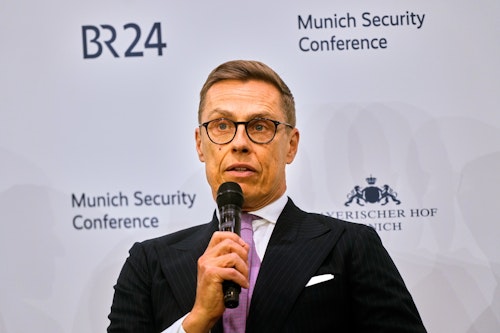
Stubb: NATO presence in the Arctic is a ‘silver lining’
Finland’s President Alexander Stubb says that a stronger NATO presence in the Arctic and stronger Arctic security would be a « silver lining » over Russian President Vladimir Putin’s actions in the region.
« At the moment, the most significant security grouping in the Arctic consists of Finland, Sweden, and Norway, and we are very focused on that cooperation. To give you one concrete example: next week there will be an Arctic training exercise involving 25,000 NATO troops, including 5,000 from the United States, in northern Norway and northern Finland, » he says.
« We are not doing this merely as a show of force. We are actively preparing for different scenarios. » He continues, « If you ask me how serious the danger is, I do not believe Russia will test the resolve of Article 5. That is precisely why deterrence exists. It is also why a country like Finland has one of the largest militaries on NATO’s eastern flank, alongside Turkey, Poland, and Ukraine. »
Credit- AP
G7 foreign ministers reaffirm support for Ukraine on MSC sidelines
Foreign ministers from the G7 – Canada, France, Germany, Italy, Japan, the UK, the US – and EU top diplomat Kaja Kallas met today on the sidelines of the Munich Security Conference.
They used the opportunity to reaffirm their « unwavering support » for Ukraine as the fourth anniversary of the start of Russia’s invasion approaches.
« Particular attention was paid to how the G7 will continue to support the Ukrainian energy sector, which faces direct Russian attacks, » they said in a statement.
They also discussed other major crises including Gaza, Iran, Venezuela, the Indo-Pacific, Sudan and Haiti.
Trump’s ‘desire’ on Greenland still ‘exactly the same’ – Denmark’s Frederiksen
Danish Prime Minister Mette Frederiksen just told the Munich Security Conference that Donald Trump is still keen to take control of the sprawling Arctic island.
« The desire from the US President is exactly the same, » she said. « We disagree as a kingdom and by the way Europe disagrees. »
Trump first issued the threat to forcefully seize Greenland last month, sparking fears of a conflict between NATO allies which would effectively spell the end of the 77-year-old military alliance. An agreement on a « framework for the future » of Greeland was agreed between Trump and NATO chief Mark Rutte on the sidelines of the Davos forum.
Trilateral talks between Denmark, Greenland and the US have been ongoing since.
Frederiksen conceded however that allies need to do more collectively to boost security in the High North.
Sánchez opposes nuclear
Back to the conference, Spanish Prime Minister Pedro Sánchez has made a case against nuclear rearmament.
Remember, both French leader Emmanuel Macron and British Prime Minister Keir Starmer hinted they would be opening talks for a common European nuclear deterrence.
« Seventy years ago, our parents and grandparents came to the conclusion that nuclear deterrence was a far too costly and risky way of avoiding conflict between nations. Too costly because it demanded colossal public investments, and too dangerous because on several occasions, technical or human errors came close to triggering a full-scale nuclear war between the West and the former Soviet Union, » Sánchez says.
« After a few decades, our predecessors realized that the risks posed by nuclear deterrence far outweighed its contributions to peace. They realized that a system that requires zero mistakes and constant correction to avoid total destruction is not a guarantee, it’s a gamble. »
Navalny killed with epibatidine, five European countries say
Russian opposition leader Alexei Navalny was poisoned by the Kremlin with a lethal toxin derived from the skin of poison dart frogs, five European countries said Saturday.
The foreign ministries of the UK, France, Germany, Sweden and the Netherlands said analysis of samples from Navalny, who died two years ago, “have conclusively confirmed the presence of epibatidine.” It is a toxin found in poison dart frogs in South America that is not found naturally in Russia, they said.
The countries said in a joint statement that “Russia had the means, motive and opportunity to administer this poison.” They said they were reporting Russia to the Organization for the Prohibition of Chemical Weapons for a breach of the Chemical Weapons Convention.
« We know now that Vladimir Putin is prepared to use chemical weapons against his own people to stay in power, » French Foreign Minister Jean-Noel Barrot wrote on X. « France pays tribute to this opposition figure, killed for his fight for a free and democratic Russia. »
Navalny, who was Putin’s fiercest critic, died in February last year while serving a 19-year sentence in an Arctic penal colony that he believed to be politically motivated.
Il y a deux ans, Alexeï Navalny décédait des suites d’un empoisonnement lié à un des agents neurotoxiques les plus mortels. Nous savons désormais que Vladimir Poutine est prêt à utiliser l’arme chimique contre son propre peuple pour se maintenir au pouvoir. La France rend hommage…
— Jean-Noël Barrot (@jnbarrot) February 14, 2026
On the sidelines: Ukraine House hosts lunch featuring leaders and disqualified Olympian
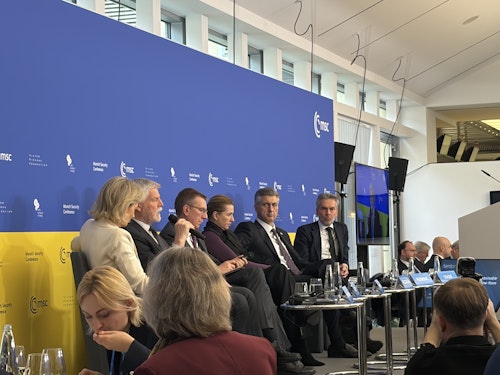
On the sidelines of the Munich Security Conference, a Ukrainian lunch hosted by the Victor Pinchuk Foundation took place at the Ukraine House, featuring a panel packed with European leaders — among them Danish Prime Minister Mette Frederiksen and Czech President Petr Pavel.
Disqualified Ukrainian skeleton pilot Vladyslav Heraskevych also attended, holding the helmet that got him barred from this year’s Winter Olympics in Milan. He was met with a standing ovation.
“If we want peace for Ukraine, and peace for Europe, we should stay united,” a Ukrainian soldier told the panel and attendees, addressing the room.
EU Commissioner for Enlargement Marta Kos added that Ukraine has brought “many positive” things to Europe, responding to a question about whether Ukraine could become a member of the European Union by 2027.
Based on the current methodology, Ukraine joining by January 2027 is “not possible,” she said, but added: “We cannot wait anymore, and we’re already discussing this.”
Putin ‘must be held accountable,’ Navalnaya says
Alexei Nalvany’s widow, Yulia Navalnaya, has just posted a statement on social media about the new discovery published by five European countries on her husband’s death.
« I was certain from the first day that my husband had been poisoned, but now there is proof: Putin killed Alexei with chemical weapon. I am grateful to the European states for the meticulous work they carried out over two years and for uncovering the truth. Vladimir Putin is a murderer. He must be held accountable for all his crimes. »
The posion in question, epibatidine, « can be found on the skin of the Ecuadorian dart frog. It causes paralysis, respiratory arrest, and a painful death, » she says.
Scientists from five European countries have established: my husband, Alexei Navalny, was poisoned with epibatidine — a neurotoxin, one of the deadliest poisons on earth. In nature, this poison can be found on the skin of the Ecuadorian dart frog. It causes paralysis, respiratory… pic.twitter.com/doHGgSgzMA
— Yulia Navalnaya (@yulia_navalnaya) February 14, 2026
What else to expect from Zelenskyy today
His keynote speech might be behind him, but there’s still plenty left on Volodymyr Zelenskyy’s agenda.
He will hold a press event at 16.20 CET and will receive the Ewald von Kleist Prize on behalf of the Ukrainian people at 19.40 CET.
The prize is « in deep recognition of their courage, sacrifice, and unwavering will to defend the freedom of Ukraine and the freedom of all Europe, and in remembrance of the many who lost their lives or were injured, » according to a release.
Other events on his agenda today included bilateral meetings with NATO chief Mark Rutte, US Secretary of State Marco Rubio, and the President of Azerbaijan, Ilham Aliyev, as well as meetings with a bipartisan delegation of US senators, and investment companies.
Five European nations say Russian opposition figure Navalny was poisoned, blame Kremlin
The foreign ministries of the UK, France, Germany, Sweden and the Netherlands said Saturday that analysis of samples from Russian opposition figure Alexei Navalny, who died two years ago, “have conclusively confirmed the presence of epibatidine.” It is a toxin found in poison dart frogs in South America.
The countries said that “only the Russian state had the combined means, motive and disregard for international law” to carry out the attack.
Navalny crusaded against corruption and the Kremlin, becoming a fierce critic and one of President Vladimir Putin’s biggest challengers. He died in an Arctic penal colony in February 2024. His widow, Yulia Navalnaya, said last year that two independent labs found her husband was poisoned before his death. Russian officials have denied wrongdoing.
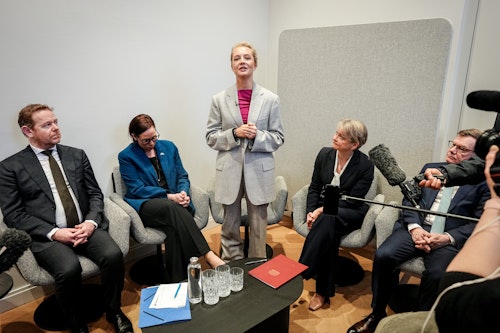
Yulia Navalnaya, human rights activist and wife of Russian opposition leader Alexei Navalny, gives a press statement on the death and circumstances of her husband’s death on the sidelines of the Munich Security Conference in Munich, Germany, Saturday Feb. 14, 2026.
Zelenskyy: ‘We can’t save lives by saying thank you’
Zelenksyy is asked about his predictions for the upcoming year and he replies his immediate concern is « tomorrow. »
« We can’t save lives by saying thank you, » he adds, concluding Ukraine needs strong security guarantees to keep it safe in the event of the conflict endings.
He also touches on Ukraine’s EU accession. The Ukrainian leader has called for a fixed deadline in Kyiv’s accession into the EU, forcing the executive to rethink its long-standing merit-based enlargement policies. Zelenskyy says he will continue to push for Kyiv’s accession.
Rutte pushes back
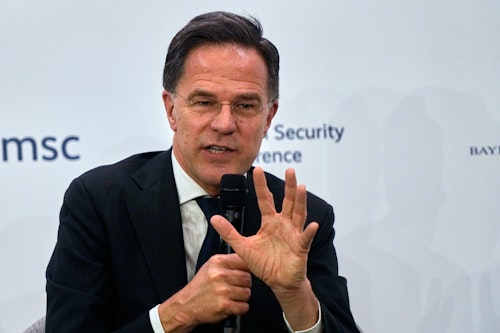
NATO Secretary General Mark Rutte has pushed back strongly on the notion there are « historical reasons » for Russia to invade Ukraine. « There was absolutely no reason whatsoever for the Russians to invade Ukraine, » he says.
« Not in 2014 with Crimea, not the full scale onslaught on Ukraine starting late February 2022. So this is absolutely, absolutely not true. Then when it comes to security guarantees, the first thing which is crucial is for NATO, that NATO came back together. »
« In the last couple of days, there has been a huge shift in mindset within NATO, where the Europeans are now taking more of a leadership role in NATO, where the Europeans take more responsibility for their own defence, » he says.
He goes on to defend US President Donald Trump’s role in the peace process, calling a 6 January meeting in Paris « successful. »
« If we agree that only the American president was able to break the deadlock with Putin, I think it was only him because he is the leader of the mightiest nation on earth, a quarter of the world economy, the mightiest military on earth. He did that in February. He broke the deadlock. »
Credit- AP
Give us a two-month ceasefire and we’ll hold elections – Zelenskyy
The Ukrainian president said that his country « is ready » to proceed with organising elections but only if a two-month ceasefire is respected.
Organising elections under bombardment is simply too difficult, Zekenskyy said. « I don’t know who has experience. We don’t have it. »
« Give us a ceasefire, President Trump can do it, » Zelenskyy said. « Our parliament can change the law and we will go to elections » if the US and Russia need electiosn to be held in Ukraine.
In a jibe at Moscow, Zelenskyy said he would be happy to hold a ceasefire in order for free elections to be held in Russia.
Europe not being at negotiating table is ‘a big mistake’ – Zelenskyy
Zelenskyy just said that Europe not being at the negotiating table is « a big mistake ».
« We Ukrainians are trying to bring Europe fully into the process, » Zelenskyy said, to ensure that Europe’s interests and voice are taken into account, and because « peace can only be built on clear security guarantees », which Europe is expected to bear the brunt of.
Ukraine will take part in another round of peace talks with the US and Russia next week, which the Ukrainian president said would hopefully be « serious » and « helpful ». He noted however that often it appears that the different sides « are talking about completely different things ».
« The Americans often return to the topic of concessions and too often those concessions are discussed only in the context of Ukraine, » he said.
« Ukraine will do everything to make these negotiations successful. We have invested in this process, » he also said, adding that he is in « constant contact » with the American team.
« Ukraine wants the result of all these efforts to be real security, and bring peace, real peace. »
Zelenskyy criticises Hungary’s Viktor Orbán
Zelenskyy has praised Ukraine and the Ukrainian people for being key to stopping Russian aggression and securing the freedom of Poland, Moldova and Romania.
He takes a public swipe at Hungarian leader Viktor Orbán, who has repeatedly blocked and criticised the EU’s ongoing support for Ukraine.
« Even one Viktor can think about how to grow his belly, not how to grow his army to stop Russian tanks from returning to the streets of Budapest,” he says.
Zelenskyy calls on EU to do more to clamp down on Russia’s shadow fleet
The Ukrainian President has now thanked the EU for the €90 billion loan to finance Ukraine’s military and financial needs for the coming two years.
He described it as a « serious guarantee of Ukraine financial stability » but called for more measures to ensure the Kremlin’s revenues run dry.
« Let’s not close our eyes to the problem, Zelenskyy said. « Russia still has accomplice regimes », he added, citing North Korea, as well as companies that allow it to circumvent sanctions, citing China.
« Putin still has guarantees of financial stability, » he noted, taking aim at the shadow fleet of oil tankers Moscow uses to continue to sell oil despite Western sanctions.
The Ukrainian president said he has discussed the issue with his European counterparts including Macron and von der Leyen, in order to update the European legislation so that these tankers can not only be detained but also blocked and confiscated.
« Without oil money, Putin would not have money for this war, » he said.
Zelenskyy has turned his attention onto Iran.
He says although Ukraine doesn’t share a border with Iran or have conflict with the Iranian regime, it continues to sell drones to Russia.
« When they have time, they only kill more. They must be stopped immediately. »
Shahed drones can now fly at different altitudes, act as ‘mother drone’ – Zelenskyy
Ukraine’s Zelenskyy has just done a recap of the attacks Ukraine came under in January, saying it had to defence itself against « 6,000 attack drones, most of them were Shahed drones » as well as « 150+ Russian missiles of different types » and glide bombs.
The Iranian-designed Shahed drone, Zelenskyy explained, has evolved tremendously since the beginning of the war nearly four years ago, when « they could be shut down easily ».
Now Shahed drones have a jet engine, enabling them to fly at different altitudes and they can be guided by an operator in real time, Zelenskyy said, citing the use of Elon Musk’s Starlink, and they « can carry other drones, acting as a mother drone ».
« The longer the war continues, the more resources the aggressor receives, » Zelenskyy said
Zelenskyy thanks European leaders for giving Ukraine air defence systems. These « save lives, » he says.
He name checks the NATO Prioritised Ukraine Requirements List (PURL) initiative, which ensures the delivery of air defence interceptors to block Russian attacks.
Zelenskyy has arrived, and he’s « setting the scene » before joining a discussion with NATO Secretary General Mark Rutte and European Parliament President Roberta Metsola.
He begins by thanking people — Rutte gets a specific thank you for his support for Ukraine.
Volodymyr Zelenskyy to take the stage
Ukraine’s President Volodymyr Zelenskyy is about to deliver a speech. Stay with us as we bring you the most important parts.
VDL tackles Rutte on ‘Dream on’ comment
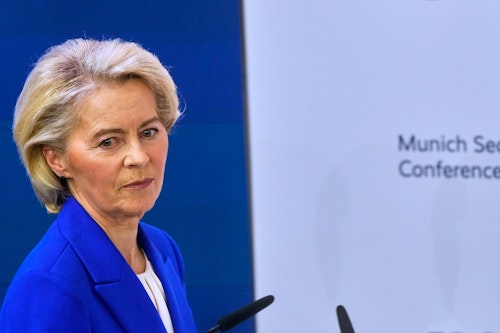
Von der Leyen has now gone on the attack on two fronts.
She took aim at Mark Rutte, the Secretary General of the NATO military alliance, who recently told the European Parliament that Europe can « dream on » if it thinks it can defend itself without the US.
« I would like to tell him, my dear friend, there is not only status quo goes on or division and disruption. There’s a lot in between, » she said, adding that this would be beneficial to both Europe and the US.
« There is much more in between and an independent Europe means let’s develop our strength without constantly leaning on someone else. »
On another matter, it was the US in her crosshairs.
« I want to very clear: our digital sovereignty is our digital sovereignty » and the EU « will not flinch where this is concerned, » she said.
Credit- AP
‘I was very much reassured’ by Rubio’s speech – von der Leyen
Asked what she thought of the speech delivered earlier by US Secretary of State Marco Rubio, the European Commission chief said she was « very much reassured ».
She described Rubio as « a good friend, a strong ally » and that she understands that « in the (US) administration some have a harsher tone on this topic, but the Secretary of State was very clear: we want a strong Europe in the alliance and this is what we are working for intensively in the EU
Starmer: Change in EU-UK relations is of ‘some urgency’
Starmer says the need to restart the UK’s relationship with the EU a decade on from the UK’s referendum is of « some urgency » in the context of the Ukraine war.
“This is of some urgency, because I think that on defence and security, until Ukraine conflict we didn’t really wake up the reality that we’re facing,” he says.
Starmer opens door to selective alignment with EU single market
Starmer has gone on to suggest the UK needs to work more closely with the EU, including looking at moving closer to the bloc’s single market in selected sectors.
The UK wants deeper cooperation on defence technology and AI to « drive greater coherence and coordination across Europe. » He singled out Germany, France, Italy and Poland alongside Norway, Canada and Turkey.
He also picks up on Macron’s comments from yesterday about a common European nuclear deterrence.
“For decades, the United Kingdom has been the only nuclear power in Europe to commit its deterrent to protect all Nato members. »
« Any adversary must know that in a crisis, they could be confronted by our combined strength,” he said.
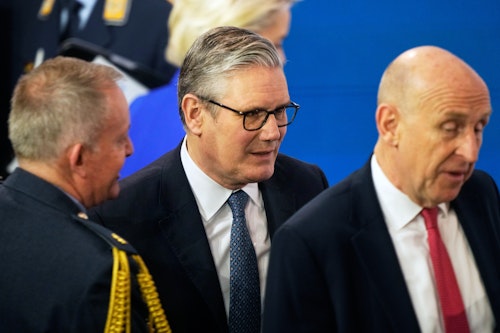
‘We are not the Britain of the Brexit years anymore,’ Starmer says
British Prime Minister Keir Starmer has delivered a message of unity between the UK and Europe, telling the audience that the « Brexit years » are over and that the UK will work primarily with Europe to ensure security.
« In a dangerous world, we would not take control by turning inward; we would not take control by turning inward; we would surrender it and I won’t let that happen. »
Starmer has been seeing rapprochement between London and Brussels since he took office, with talks on deeper trade, customs and defence accelerating on the 10th anniversary of the referendum that thrust the UK’s role in the European Union into turmoil.
Credit- AP
EU must use qualified majority and partnerships with third countries for its defence – VDL
But the head of the EU executive also stressed that in order to truly be ready to be in position to defend itself, the EU « must make decisions faster ».
« And this may mean relying on the result of a qualified majority rather than unanimity. We do not need to change the Treaty for this. We need to use the one we have, » Ursula von der Leyen said.
She also called for the bloc to be « creative », notably through partnership with other partners, citing the UK-led Joint Expeditionary Force and the Coalition of the Willing for Ukraine.
« What we need to do now, is formalise the ad hoc beginnings of new security collaborations. This starts by working of course with our closest partners, like the UK, Norway, Iceland or Canada, » she said.
« We want to increase our offer to many of these vital partners. This means, in this acutely volatile time, Europe and in particular the UK should come closer together – on security, on economy or on defending our democracies. »
Europe’s mutual defence clause must be brought ‘to life’ – VDL
Ursula von der Leyen is now talking defence saying Europe is « delivering » with spending in Europe up by nearly 80% since before the war in Ukraine.
« By 2028, defence investment in Europe is even projected to exceed the amount the US spent on such equipment last year. This is a true European awakening, » she added.
But Europe must go beyond just spending, the Commission chief said, and « no taboo can go unchallenged ».
« I believe the time has come to bring Europe’s mutual defence clause to life. Mutual defence is not optional for the EU. It is an obligation within our own Treaty – Article 42(7). For good reason. It is our collective commitment to stand by each other in case of aggression. Or in simple terms, one for all and all for one.
« This is Europe’s meaning. But this commitment only carries weight if it is built on trust and capability, » she said.
‘Europe must become more independent’ – Ursula von der Leyen
European Commission President Ursula von der Leyen has now taken to the stage, starting with a simple message: « Europe must become more independent – there is no other choice. »
« The European way of life – our democratic foundation and the trust of our citizens – is being challenged in new ways. On everything from territories to tariffs or tech regulations, » she said, in a thinly-veiled reference to the US, but also citing Russia’s ongoing aggression against Ukraine.
This independence must be wide-ranging and cover areas including « Defence and energy. Economy and trade. Raw materials and digital tech, » she said
« Some may say the word ‘independence’ runs counter to our transatlantic bond. But the opposite is true. An independent Europe is a strong Europe. And a strong Europe makes for a stronger transatlantic alliance, » she also said.
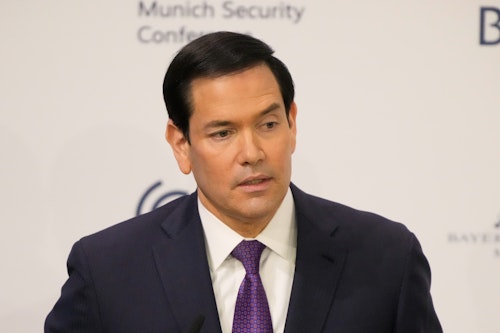
Rubio on Ukraine
Onto a Q&A, Rubio answers a question on Ukraine.
The Secretary of State skipped an informal meeting on the conflict yesterday which was attended by multiple European leaders.
According to Rubio, the issues between Russia and Ukraine have « narrowed » but « the hardest questions to answer » remain. He pushes back on the idea Moscow is not interested in negotiations.
The US and Europe should continue to take steps to pressure Russia into negotiations, Rubio says, insisting the US has « made progress » in talks.
Credit- AP
US wants to ‘fix’ the status quo, Rubio says
Rubio goes on to offer a brief message of reassurance for European allies, insisting the US does not want to « separate » but to « revitalise » an old friendship.
“In a time of headlines heralding the end of the transatlantic era, let it be known and clear to all that this is neither our goal nor our wish, because for us Americans, our home may be in the western hemisphere, but we will always be a child of Europe.”
He also references NATO troops, saying the US has « bled and died side by side. » As a reminder, US President Donald Trump sparked anger in January when he undermined the role of NATO troops in Afghanistan, claiming they « stayed a little off the frontlines. »
Rubio: Decline is a choice
Rubio has evoked a parallel between what he says was « decline » rejected after 1945 and should be rejected now as well.
“We do not want our allies to be weak, because that makes us weaker. We want allies who can defend themselves, so that no adversary will ever be tempted to test our collective strength. This is why we do not want our allies to be shackled by guilt and shame. »
« We want allies who are proud of their culture and of their heritage, who understand that we are heirs to the same great and noble civilization, and who, together with us, are willing and able to defend it, and this is why we do not want allies to rationalise the broken status quo rather than reckon with what is necessary to fix it. »
UN needs urgent reform, Rubio says
According to Rubio, international organisation such as the UN need to be rebuilt and urgently reformed.
The UN, he says, has proven itself « powerless » during key wars in Gaza and Ukraine.
“In a perfect world, all of these problems and more would be solved by diplomats and strongly worded resolutions. But we do not live in a perfect world, and we cannot continue to allow those who blatantly and openly threaten our citizens and endanger our global stability to shield themselves behind abstractions of international law which they themselves routinely violate.”
Rubio: US ‘cares deeply’ about Europe
Marco Rubio has dedicated some of his speech to underline the close links between Europe and the US, such as « “shared history, Christian faith, culture, heritage, language, ancestry and past sacrifices.”
He lists a number of famous Europeans such as Mozart, Shakespeare and The Beatles as reasons why Europe is special.
He goes on to say, « So this is why we Americans may sometimes come off as a little direct and urgent in our counsel. … The reason why, my friends, is because we care deeply. »
« We care deeply about your future and ours, and if at times we disagree, our disagreements come from our profound sense of concern about a Europe with which we are connected, not just economically, not just militarily, we are connected spiritually and we are connected culturally.”
Snap analysis: Rubio’s speech
Marco Rubio was supposed to be a nicer, more polite version of J.D. Vance. But so far, his Munich speech reiterates the same points made by the US vice president last year.
In his speech, he is lambasting the outsourcing sovereignty to multinational institutions, a “climate cult” impoverishing people and mass immigration that is a threat to the cohesion of society.
Post-war delusion made by Europe and US, Rubio says
In a speech heavy on history, Rubio continues with explaining that Europe and the US created a « post-war delusion. »
“We increasingly outsourced our sovereignty to international institutions, while many nations invested in massive welfare states at the cost of maintaining the ability to defend themselves,” he says, whilst calling a « dogmatic vision of free and unfettered trade, » a delusion.
“In a pursuit of a world without borders, we opened our doors to an unprecedented wave of mass migration that threatens the cohesion of our societies, the continuity of our culture and the future of our people,” Rubio says.
Rubio has started his speech referencing the history of the Munich Security Conference.
“We gather here today as members of a historic alliance, an alliance that saved and changed the world. When this conference began in 1963 it was in a nation, actually, it was on a continent that was divided against itself. The line between communism and freedom ran through the heart of Germany. »
“At that time, victory was far from certain, but we were driven by a common purpose. We were unified not just by what we were fighting against, we were unified by what we were fighting for,” Rubio says.
“The euphoria of this triumph led us to a dangerous delusion that we entered ‘the end of history’ and every nation would now be a liberal democracy, that the ties formed by trade and by commerce alone would now replace nationhood, that the rules based global order, an overused term, would now replace the national interest, and that we would now live in a world without borders, where everyone became a citizen of the world.”
« This was a foolish idea. »
Rubio is speaking
US Secretary of State Marco Rubio has taken the floor. Stay tuned.
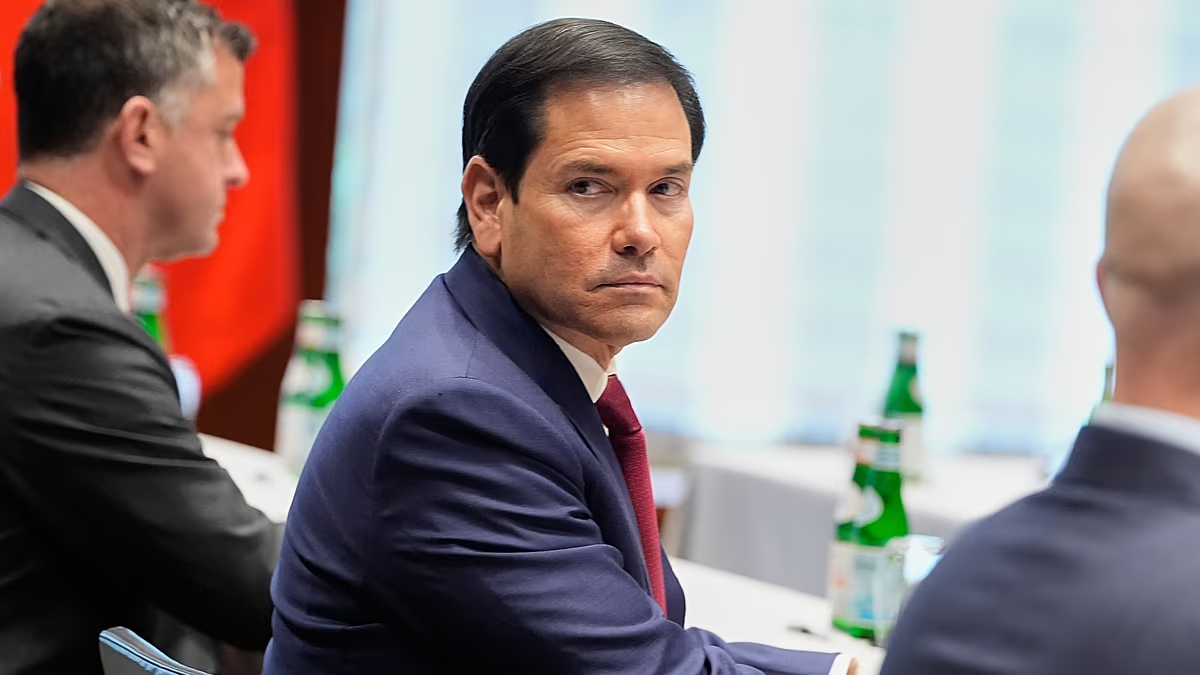
Rubio skips Berlin Format talks on Ukraine in Munich
Peace efforts in Ukraine are top of the agenda at this year’s conference but at a Berlin Format meeting, attended by leaders from a dozen European countries, US Secretary of State Marco Rubio was a no-show.
My colleague Johanna Urbancik has more.
Rubio skips Berlin Format talks on Ukraine in Munich
Russia’s war on Ukraine is at the top of this year’s agenda at the Munich Security Conference, with European leaders trying to keep the United States involved…
Good morning
Good morning and welcome to our live blog on the second day of talks between the world’s top security leaders.
Here’s a quick recap of what stood out yesterday:
- Germany’s Chancellor Merz delivered a dramatic speech which set the tone for the next three days. In it, he said the world order as it has stood for decades « no longer exists » and that a new world order of « power politics » puts even the strongest nations in danger. He dubbed the tension between the EU and the US an « inconvenient truth », said there was a « divide » between the continents and that « freedom could no longer be taken for granted » against the ongoing threat from Moscow.
- Elsewhere, US Ambassador to the UN Mike Waltz and the EU’s Foreign Policy Chief Kaja Kallas sparred on spending with Waltz noting that continued payments for international organisations, such as the UN, have become hard to justify to US voters. Kallas told Waltz that « when America goes to wars, then a lot of us go with you, and we lose our people on the way. You also need us. »
- Finally, French President Emmanuel Macron praised Europe in a speech that set out a positive view of what the continent could achieve. He mentioned planning « coexistence » with Russia, a new European nuclear sharing programme and pushed back on the notion that Europe was over-regulating its social media platforms.
First up is US Secretary of State Marco Rubio, who is set to deliver a speech one year after Vice President J.D.Vance stunned the same conference with a blistering attack on European countries. Stay tuned —we’ll deliver the main lines as we get them.